On my first visit to Hiroshima, I stood in front of the Hiroshima Hypocentre Monument when an older woman approached me. She asked where I was travelling from, then mentioned she was only a few kilometres away when the bomb dropped in 1945. She thanked me for visiting and walked on. Even writing this now, remembering our small conversation, sends shivers down my spine. I’ve thought about her many times since.
At the time, I was spending a full week in Hiroshima, and I’ve been back for a second visit since. Even though the city is mainly known through black and white images displaying the aftermath of the bomb, Hiroshima has rebuilt itself as a warm, welcoming and thriving space promoting peace. I loved the time I spent here.
By Shinkansen, it only takes 1 hour and 30 minutes to get to Hiroshima from Osaka, making it a great day trip if you’re short on time. The eight stops I added to this itinerary are easy to follow, with the Peace Memorial Museum saved for last for a reason. It’s one of the most moving places I’ve visited anywhere in the world, and you want to take your time.
- Hiroshima Day Trip Overview & Map
- One Day in Hiroshima: Tried & Tested Itinerary
- 1. Visit Hiroshima Castle
- 2. Walk Around the Atomic Bomb Dome
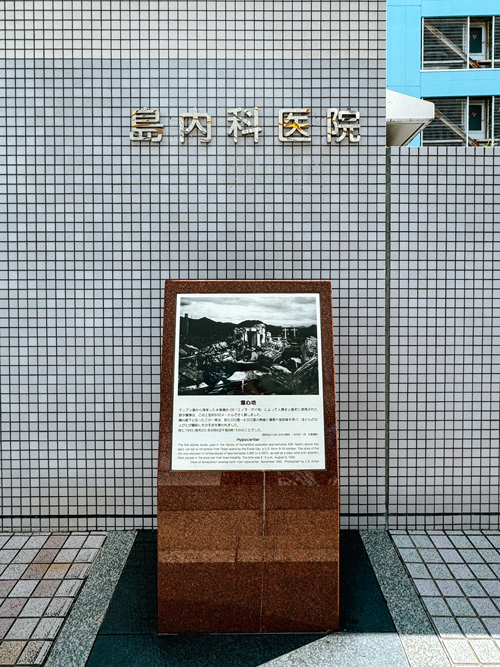
- 3. See the Hiroshima Atomic Bomb Hypocentre Monument
- 4. See Some of the Monuments in the Peace Memorial Park
- 5. Stop by the Hiroshima Peace Memorial Park Rest House
- 6. See the Flame of Peace
- 7. Visit the Hiroshima Peace Memorial Museum
- 8. Eat Hiroshima-Style Okonomiyaki
- How to Get to Hiroshima
- Can You Do Hiroshima as a Day Trip?
- Final Thoughts on Visiting Hiroshima
What’s New in 2026?
Hiroshima Castle has been closed since March 2026 for renovations. You can still visit the castle grounds and gardens, but you can no longer go inside.
If you’re visiting Hiroshima between August 8 and August 16, you have to make an online reservation for the Hiroshima Peace Museum. No walk-in tickets will be available. Visitor limits are capped at 1,000 people per hour during this time. You can pre-book tickets 90 days in advance on Klook (click here).
Key Takeaways
– Hiroshima is 1 hour and 30 minutes from Osaka, or 1 hour and 40 minutes from Kyoto by Shinkansen.
– Visiting the Peace Memorial Museum is an emotional experience, one you do not want to rush. Plan 2–3 hours for it and do it as one of the last things on your day trip.
– One day is enough for a loop around the main sights, but staying at least two days and adding a day trip to Miyajima is the best way to see Hiroshima.

Hiroshima Day Trip Overview & Map
If you only have one day in Hiroshima, I recommend visiting Hiroshima Castle, the Peace Memorial Museum and the surrounding sights.
To get around the city, you can use the trams that connect all parts of the city. You can use your Suica/Pasmo card to pay per ride. Alternatively, you can get the Hiroshima Tourist Pass for one day, which gives you unlimited rides on public transport within the city.
Travel Tip
As one day is quite short in Hiroshima, you may want to consider hiring a private guide for the first half of your day. They can guide you through part of this itinerary and give you additional information on what happened in Hiroshima. We took a guided tour on one of our days in the city, and it added a lot of value. You can book a tour guide here.
For the remainder of the day (or if you want to DIY your full day in Hiroshima), you can use my Google Maps that highlights all the spots on this itinerary:

One Day in Hiroshima: Tried & Tested Itinerary
This is the Hiroshima itinerary I recommend if you only have one day:
1. Visit Hiroshima Castle
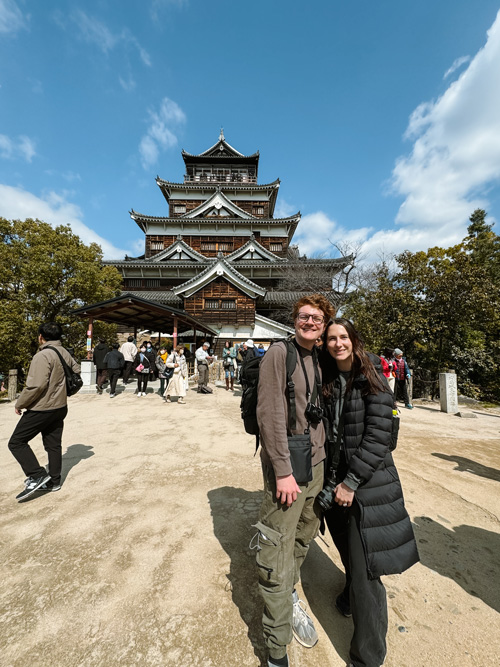
After arriving in Hiroshima from Kyoto or Osaka, your first stop will be Hiroshima Castle. From Hiroshima Station, it’s a 20-minute walk to get to the castle. You can also use the bus. You can visit the grounds of Hiroshima Castle for free.
Hiroshima Castle, also known as Carp Castle, was originally built at the end of the 16th century and was named a National Treasure in 1931. Unfortunately, it was completely destroyed by the atomic bomb. The current castle was built in 1958, 13 years after the bombing.
There isn’t a lot to see on the castle grounds, as not all the buildings have been restored. But it was turned into a lovely green area, so it makes for a lovely start to your day in Hiroshima.
2026 Notice
On 22 March 2026, Hiroshima Castle closed for structural renovation due to signs of ageing. You can still visit the grounds, but you’re no longer able to go inside. No confirmed reopening date has been announced. You can still get the stamp pictured below in front of the castle.


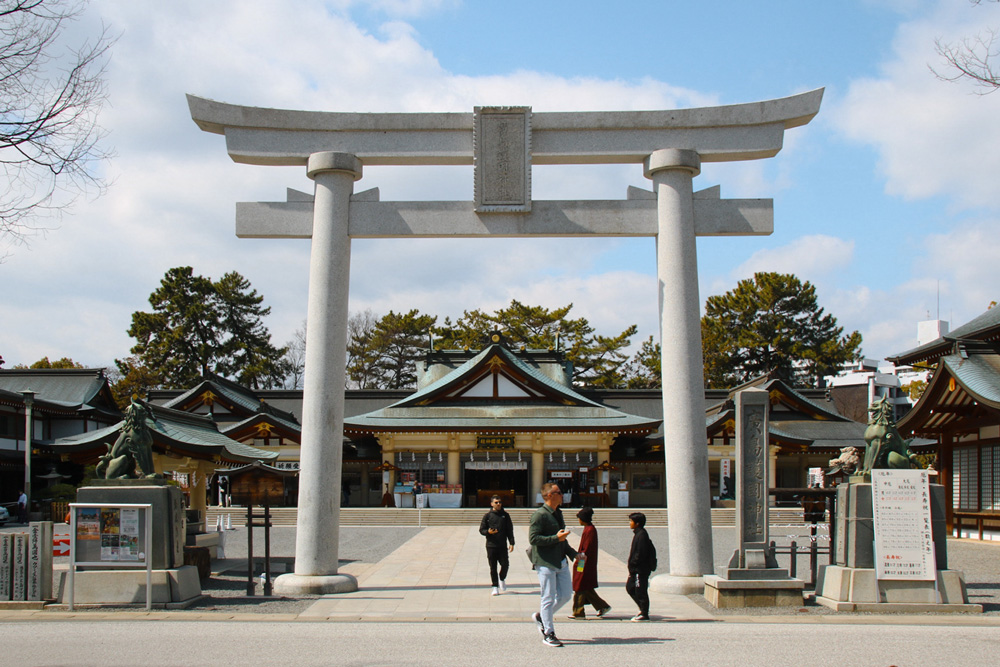
It is worth stopping by Gokoku Shrine before you leave the castle grounds. This Shinto Shrine was also rebuilt after being destroyed by the bomb. It’s still one of the largest Shinto Shrines in the city and a popular spot for New Year’s celebrations.
Another special spot to check out before you leave is the large Eucalyptus tree right before the exit. It stands only 740 meters from the hypocentre of the atomic bomb, and it somehow survived the blast. On our walking tour, the guide showed us a black-and-white picture of it standing tall among the rubble.


Stay connected to the internet during your trip to Japan (essential for using apps like Google Maps & Translate!) with an eSIM. Journey Japan eSIM specialises in eSIMs in Japan, making them the best option for your next trip. (Read our full review here)
2. Walk Around the Atomic Bomb Dome
From Hiroshima Castle, you can walk through Hiroshima Gate Park towards the Atomic Bomb Dome (Genbaku Dome). This should take around 15 minutes.
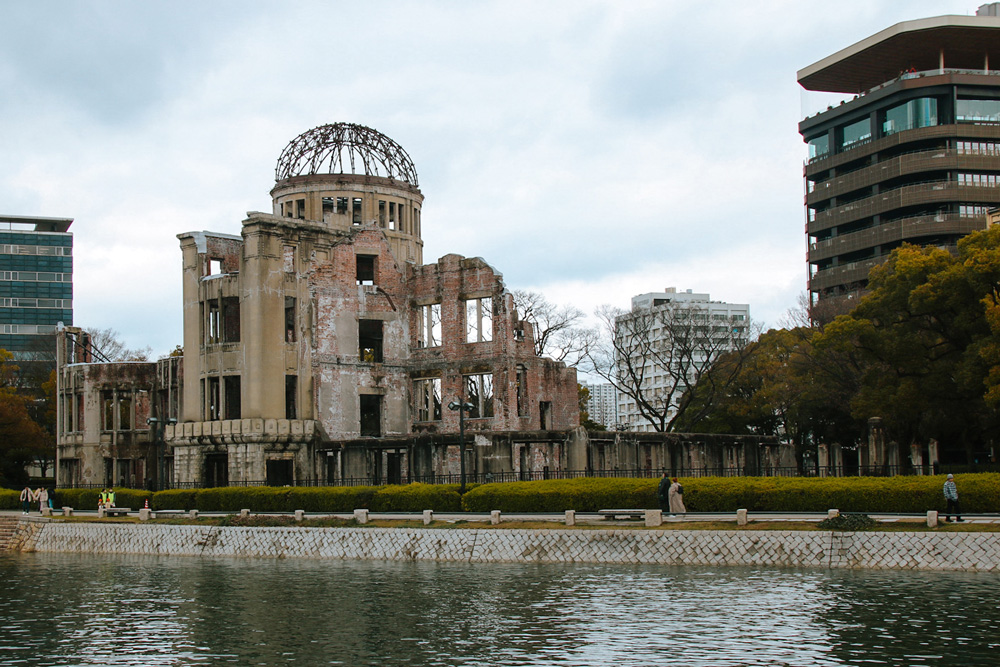
After the bomb flattened most of the city, the Atomic Bomb Dome (formerly known as the Hiroshima Prefectural Industrial Promotion Hall) was one of the very few buildings that remained upright. Especially since it’s located so close to the hypocentre of the bomb, it’s a miracle that some parts of it weren’t completely destroyed.
In the end, it was decided to preserve the building in this state, as a symbol of what happened here on 6 August 1945. In 1996, it was designated as a UNESCO World Heritage Site.
You can’t enter the building for obvious reasons, but you can walk around its remaining shell. It’s a sobering sight, knowing that everything surrounding this building was wiped away within seconds after the bomb detonated.

Just behind the Atomic Bomb Dome, you can find the Hiroshima Orizuru Tower. From the observation deck, you’ll get a beautiful view over the Peace Memorial Park, the Atomic Bomb Dome and the city’s skyline. While beautiful, I think the ¥2,200 entree fee per person is pretty steep. I’d personally skip it in the future.
3. See the Hiroshima Atomic Bomb Hypocentre Monument
At 8:15 am on 6 August 1945, the world’s first atomic bomb was dropped. It exploded around 600 meters above this exact spot and almost instantly destroyed the city. Tens of thousands of people died instantly, and in the weeks and months following the attack, even more died due to radiation poisoning. In total, it’s estimated that the bomb killed 140,000 people by the end of 1945.
The Hypocentre Monument is a bit tricky to find as it’s located between a couple of tall buildings on a regular street. It only takes a couple of minutes to get there from the Atomic Bomb Dome, so it’s definitely worth stopping by. It’s chilling seeing it and standing there.
When Richard and I were reading the plaque, an older Japanese lady stopped by and asked us where we were from. We had a short chat, but during this, she told us she was only a couple of kilometres away when the bomb dropped. I still think about her whenever I hear anything about Hiroshima, especially after having visited the museum right after meeting her. Our short chat left quite an impression on me.

4. See Some of the Monuments in the Peace Memorial Park
Located on a sort of island between two rivers in the heart of Hiroshima, the Peace Memorial Park is a quiet park remembering all the lives that were lost in the aftermath of the world’s first nuclear bomb.
Inside the park, you can find countless monuments. One of the most famous ones is the Children’s Peace Monument, dedicated to the children who died during the attack. The statue of the little girl holding a folded paper crane is based on Sadako Sasaki.
As a result of the bomb, she developed leukaemia and sadly passed away. In the hospital, she started her goal to fold 1,000 paper cranes. According to a Japanese legend (senbazuru), you’ll be granted a wish if you fold over 1,000 paper cranes.
Nowadays, people worldwide send paper cranes to Hiroshima as a symbol of peace. Thousands of them are now hung near her statue. Countless paper cranes are added constantly, so older ones are recycled and made into postcards, which you can buy at the tourism centre next door.


5. Stop by the Hiroshima Peace Memorial Park Rest House
Before we head over to the Peace Memorial Museum, I think it’s also worth stopping by the Rest House. In 2020, the building was completely renovated and opened as a tourist centre. It’s free to visit, which also includes the basement exhibition. I’m surprised it’s not on more itineraries as I think it’s an unmissable sight in Hiroshima.
On the day of the bombing, 37 people were working inside the building. Only one of them, Eizo Nomura, survived, as he was in the basement looking for some documents at the time the bomb exploded.
In the basement, you can find an exhibition displaying the memoirs of Eizo Nomura. You can read about what he experienced and saw, along with drawings and photos of the bomb’s aftermath. It’s quite chilling and sobering to read, but I think it adds a lot to your visit to Hiroshima.
6. See the Flame of Peace
When making your way to the Hiroshima Peace Memorial Museum, you’ll pass the Flame of Peace. There are a lot of peace monuments to see in the park and on the walk leading up to the museum, but the Flame of Peace deserves an extra mention here.
When I walked by it the first time, I thought the flame represented that we now live in peace. A symbol that peace is maintained, but that’s not it.
On our walking tour, we learned that the flame shows that nuclear weapons are still in existence. The flame was lit on 1st August 1964 and will burn until all nuclear weapons have disappeared from this world. A powerful symbol.

7. Visit the Hiroshima Peace Memorial Museum
If you only have one day in Hiroshima, you can’t skip the Peace Memorial Museum. While very heavy and emotional, the museum is something I will never forget. The exhibition guides you through the events of the bombing, shows stories and photos of the people of Hiroshima and left me with a lump in my throat on multiple occasions.
Seeing the artefacts, the belongings of people who didn’t survive, and the letters of people who did survive made it all feel way more real. It’s a chilling, deeply moving experience. I won’t share too much about what’s inside, as I believe the museum does an incredible job at educating visitors.
Obviously, we all know what happened here, but reading the stories of people who lived through it added so many layers of the horrors and suffering that occurred here. Some of it is quite graphic, but it really shows the horrors of what happened here. I thought of the woman who spoke with us at the hypocentre memorial, and I couldn’t even imagine the horrors she must have lived through, especially seeing everything in the museum.
2026 Notice
If you’re planning to visit the museum between August 8 and August 16, you have to make an online reservation. Visitor limits are capped at 1,000 people per hour, and no walk-in tickets will be available. You can pre-book tickets 90 days in advance on Klook.
Travel Tip
Visit the Hiroshima Peace Memorial Museum last, not first. It’s emotionally heavy enough to affect everything that comes after, including your ability to engage with the rest of the city. I was lucky enough to have a full week in Hiroshima when I visited the museum, and I went back to my hotel room afterwards, not really wanting to do anything else.


Tickets to enter are only ¥200 (with discounts available for high school students). It’s best to account for around 2–3 hours of visiting the whole museum.
Many of the signs are in English too, so it’s not a problem if you don’t speak Japanese. There is also an option to get the audio guide for an additional ¥500. The opening times differ slightly depending on what month you visit, but you can find all the accurate opening times on the official website.
For this Hiroshima day trip itinerary, I’ve put visiting the museum as one of the last things to do. The reason for this is that it’s a very emotional experience. We were lucky that we had a couple of weeks in Hiroshima because after we visited the museum, we both didn’t feel like doing anything else afterwards.
I think it’s important for everybody to visit it and learn about Hiroshima’s devastating history and how it impacted so many lives, but don’t be surprised if the visit itself impacts you more than you may expect.

Depending on how much time you have left after visiting the museum, you can head towards Hondōri Shopping Street. This covered shopping street has lots of shops and places to eat and drink.
8. Eat Hiroshima-Style Okonomiyaki
Before heading back to Kyoto or Osaka, you can’t leave Hiroshima without having Hiroshima-style okonomiyaki. Okonomiyaki is a very popular dish in Japan, especially in Hiroshima and Osaka. It’s essentially a savoury pancake with cabbage, egg, flour and other ingredients of choice.
Osaka-style and Hiroshima-style okonomiyaki are quite different, though, so it’s worth trying the Hiroshima-style version while in the city. I personally prefer it over the Osaka-style version (don’t tell Osaka!).
In Osaka-style okonomiyaki, all the ingredients are mixed together before the mixture is put on the grill. Hiroshima-style okonomiyaki layers the ingredients and cooks them separately. They often also include yakisoba noodles and a fried egg. Delicious!


There are countless spots to try okonomiyaki in Hiroshima, but the best one I had during my time in the city was at Hiroshima Okonomi Monogatari. It’s located near the station, making it the perfect stop before heading back to Osaka or Kyoto.
It’s located on the 6th floor, and there are 15 different okonomiyaki stalls to choose from. Most of them make the dish on the grill in front of you. It’s super fun and absolutely delicious!
Okonomimura is another popular spot to try Okonomiyaki, which is located a bit closer to the city centre. It’s a similar concept, where multiple okonomiyaki restaurants offer dining experiences. I personally preferred Okonomi Monogatari, though!

How to Get to Hiroshima
You can easily take a day trip to Hiroshima from Kyoto or Osaka. I wouldn’t advise taking a day trip to Hiroshima from Tokyo, as it’s way too much travelling for one day (around four hours on the bullet train one way). Below, I’ll explain the easiest and cheapest routes to take:
How to Take a Day Trip to Hiroshima from Kyoto
Taking a day trip to Hiroshima from Kyoto is best done by Shinkansen (bullet train). From Kyoto Station, you can use the Tokaido or Sanyo Shinkansen Line to get to Hiroshima Station in around 1 hour and 40 minutes without changing trains.
You can also get on a train to Shin-Osaka first, and change to the Shinkansen to Hiroshima. This will take a bit longer, so it’s better to use the first, direct option.
Cheaper bus services are running between Kyoto and Hiroshima. However, these will take a lot longer (between six and eight hours). Unless you’re taking an overnight bus, this may not be an option if you only have one day in Hiroshima.
If you’re using the JR Pass, you will have to pay a supplement when using the Nozomi and Mizuho services. With the Kansai-Hiroshima Area Pass, the journey between Shin-Osaka and Hiroshima on the Nozomi and Mizuho services is included without the need to pay a supplement charge.

Find the best areas and hotels to stay in Kyoto, and check out our 2-day Kyoto itinerary (including a free walking route through the old Geisha districts).

How to Take a Day Trip to Hiroshima from Osaka
Taking a day trip to Hiroshima from Osaka is also best done by Shinkansen. You’ll first have to get to Shin-Osaka Station, which is Osaka’s Shinkansen station. From there, you can get on the Sanyo Line, which will take you to Hiroshima Station within 1 hour and 30 minutes.
If you’re using the national JR Pass, you’ll have to pay a supplement charge when using the Nozomi and Mizuho services. As it’s not a lot faster than the Sakura Shinkansen, I’d recommend using the Sakura service instead and saving some money.
With the Kansai-Hiroshima Area Pass, the full journey is covered, including Nozomi and Mizuho services, and there is no need to pay the supplement charge. You can buy the pass here.
You can also use the Hikari service, which is a bit slower and will take around 2 hours and 15 minutes. The local train between Osaka and Hiroshima is a lot cheaper than the Shinkansen, but it’ll take six hours, which won’t be an option if you’re planning to spend only one day in Hiroshima.
Taking the bus is another cheap alternative, but again, this will take a lot longer. There is an overnight bus option, leaving Osaka around 11–11:30 pm and getting you to Hiroshima for around 5–6 am.
Travel Tip
Our accommodation guide can help you find the best areas and hotels in Osaka, plus our one-day Osaka itinerary includes a free route to follow to see the main sights.
Can You Do Hiroshima as a Day Trip?
While it’s totally possible to visit Hiroshima on a day trip from Osaka or Kyoto, I would recommend staying for at least a couple of days. Hiroshima is a place that will stick with you. Visiting the Peace Memorial Museum and Peace Park is an important reminder that we can learn from history.
We have a full guide on where to stay in Hiroshima for the best areas and hotels. My personal favourites are Nekoyacho and Rihga Royal Hotel Hiroshima.
Hiroshima has rebuilt itself to become a centre of peace, and it would be a shame to have to rush through some of these important places. Especially as the Peace Memorial Museum will undoubtedly leave you a bit unsettled, it would be ideal to spend a bit longer in Hiroshima.
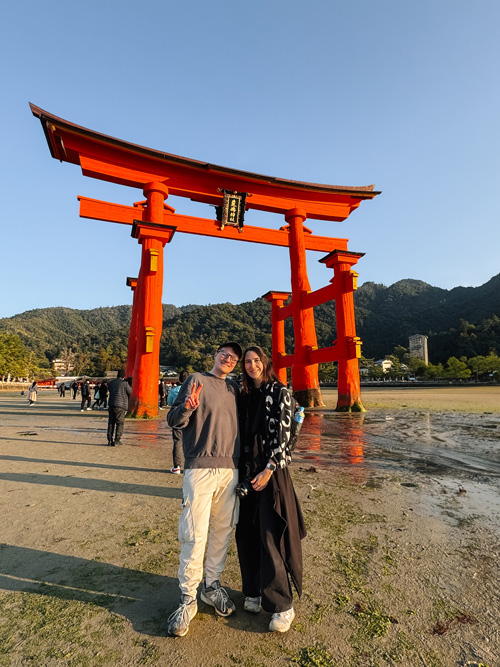
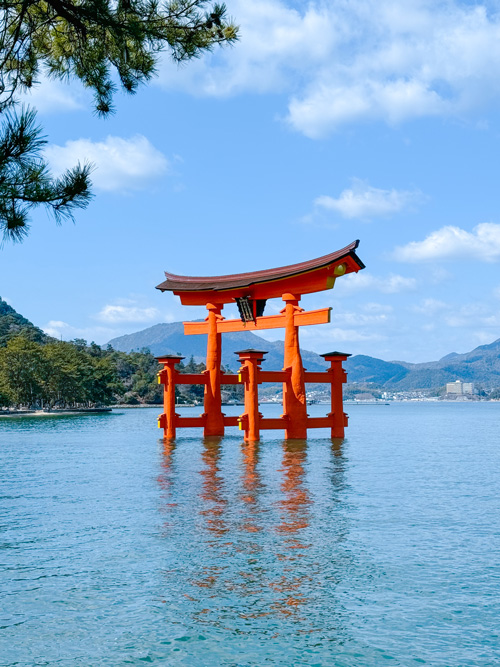
On top of that, adding a day trip to Miyajima from Hiroshima is something I’d highly recommend. This beautiful island is famous for its iconic floating torii gate and makes for a perfect addition to your Hiroshima itinerary.
However, I understand that there are countless places in Japan you probably want to visit, and it’s impossible to cram them all into a short itinerary. That’s why I’ve put together this one-day itinerary, so you’ll still be able to see the main highlights on a day trip. You can always come back in the future!
Final Thoughts on Visiting Hiroshima
Hiroshima is one of the most important places you can visit in Japan, which is why it’s part of my larger 2 week and 3 week Japan itinerary.
If you have more than one day in Hiroshima, you can add Miyajima as a day trip. Iwakuni is also a nearby city that’s worth visiting.
When travelling from Osaka, you can also stop at Himeji, Kurashiki or Onomichi on the way if you have a fw days in Hiroshima. After visiting Hiroshima, you can get to Fukuoka in just an hour, which makes for a great base to start exploring Kyushu. Or, you can take the ferry from Hiroshima directly to Matsuyama and start a trip through Shikoku, my favourite part of Japan.







This was really helpful! We followed most of this guide for a day trip from Kyoto and it worked out perfectly. We hired e-bikes from a place just over the bridge from the station for $15 Aud for the whole day and they made the journey enjoyable and our movements speedy. Would highly recommend this, especially if you come in summer as we have. Currently enjoying Okonomiyaki at the place across from the station as suggested and it’s delicious. Thank you so much!
I love your website so much! I have also subscribed to your newsletter as it is so helpful! 🙂
Do you know if the typical pancakes can also be ordered veggie? My husband and I do not eat any meat (he does not eat fish either, but I do).
Thank you so much for all the work you put into this!
Love from Germany,
Vanessa
Thank you so much Vanessa! There are some vegetarian options in Hiroshima too, including Nagataya and Hiroshima Okonomiyaki ROKU ^_^
One thing I think get’s missed a lot when people talk about Hiroshima is the nearby Yamato Museum in Kure and the JSDF submarine display. If I had know about Kure earlier I would have travelled to include this area as well. It leaves me something to go back for!