Being Japan’s first permanent capital before it changed to Kyoto in 794, Nara is filled with history. Not only that, but the city is home to eight UNESCO World Heritage Sites, including Todai-ji Temple, which houses one of the largest bronze Buddha statues in the country. And, of course, the hundreds of deer that roam the inner city.
I’ve been to Nara quite a few times over the years, and especially now that I’ve seen more of what the rest of the Prefecture has to offer, I keep going back. While it’s not always possible to spend more than one day in Nara due to time constraints, an overnight stay is very much worth considering!
However, if you only have time for a day trip to Nara, I’ve put together this guide and walking route so you can make the most of your time here!
* On our most recent visit to Nara, we worked with the Nara Tourism Board to update this guide with more insider information and recommendations. All views and opinions are my own.

Nara Itinerary Overview & Map
If you don’t have time to read the full guide, use this overview instead. The map below shows you the self-guided walking route I planned out. It guides you through the following highlights:
- Arrive in Nara at JR Nara Station or Kintetsu-Nara Station
- Kofuku-ji Temple
- Nara Deer Park
- Kasuga Taisha Shrine
- Mizuya Chaya
- Todai-ji Temple
- Yoshikien
- Isuien Garden.

On one of our last visits to Nara, we also made a YouTube video that follows this itinerary in case you want a more visual idea of what Nara is like:
Nara Day Trip Itinerary
Here is my in-depth one-day Nara itinerary for first-time visitors:
1. Arrive in Nara
Whether you’re travelling from Kyoto, Osaka or another city, try to get to Nara before 10 am. If you’re only taking a day trip to Nara and aren’t staying overnight, you want to make the most of your limited time here.
Nara has two main train stations: JR Nara Station and Kintetsu-Nara Station.
If you arrive at JR Nara Station, you can start your day by visiting the Tourist Information Centre. It’s located outside the station and offers free booklets about the deer park, the shrines and temples. There is luggage storage available, along with a Starbucks. This station sits a bit further from the main area compared to the other station, but it’s only a short walk to get to our first stop.
On my last visit to Nara, I also noticed that this station has a fortune-telling station for Nara Prefecture. In Japanese culture, omikuji is a form of fortune-telling that’s often found at shrines.
You shake a box with sticks until one of the sticks falls out. The stick has a number on it, which you can match with one of the drawers. Inside the drawer, you’ll find your fortune. What’s special about this one is that it includes a “lucky spot” in Nara that you can visit. It’s such a fun way to promote different areas in Nara! I’ve added a photo of the one I got below.
Nara’s other station, Kintetsu-Nara Station, is located a bit closer to the sights we’re going to explore today. This station also has luggage storage available. Later in this article, I’ll go over the routes you can take from Osaka or Kyoto, including what lines you can use with different passes (including the JR Pass and Kintetsu Rail Pass).

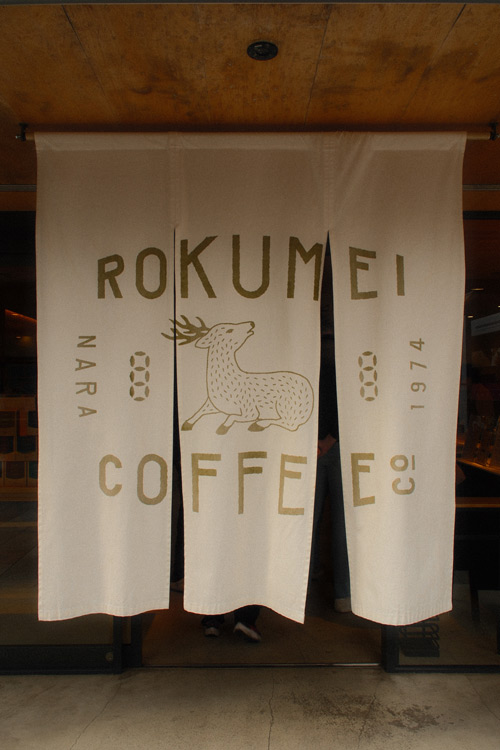
Not far from Kintetsu-Nara Station, you can find an amazing coffee shop called Rokumei Coffee. If you’re still looking for a spot to grab breakfast, this is the one! Along with their range of coffee, they sell fresh, flaky croissants.


2. Visit Kofuku-ji Temple
Normally, I would suggest starting your one day in Nara at Sarusawa-Ike Pond Park. However, since the pagoda that normally leaves a beautiful reflection in the still water is currently under construction, there isn’t much to see here. Renovations are expected to last until 2031, so unless you’re planning your Nara itinerary way in advance, you can skip it.
So instead, I would start at Kofuku-ji Temple. If you arrive in Nara at Kintetsu-Nara Station, you can walk through Higashimuki Shopping Street and then onto Sanjo Dori Street to get here. From JR Nara Station, you can follow Sanjo Dori Street. Both streets have lots of shops selling souvenirs, street food and more.
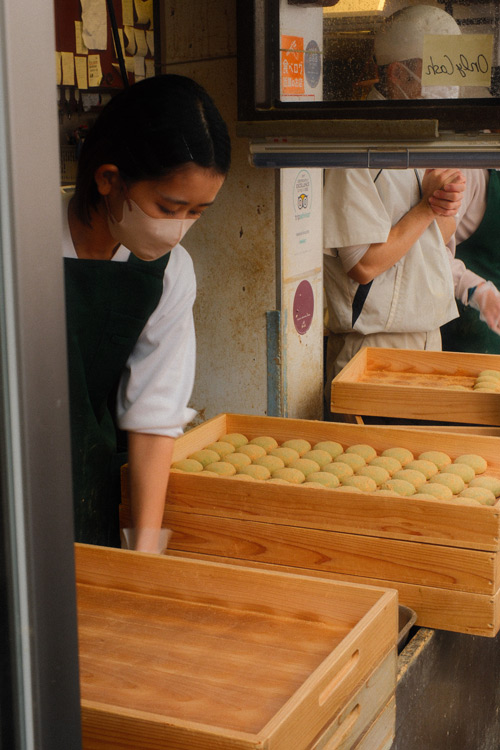
On the crossing of Higashimuki Shopping Street and Sanjo Dori Street, you can also find Nakatanidou, the viral mochi-pounding shop. Multiple times a day, they make fresh mochi with a special mochi pounding technique called mochitsuki.
The crowds near this shop during the mochi pounding are crazy, almost uncomfortably so. We skipped watching the mochi pounding and stopped by the shop a bit later to try the fresh mochi once the crowds had died down.

Once you’ve made your way through the first few streets, you’ll have arrived at our first proper sight: Kofuku-ji Temple, one of Nara’s eight UNESCO World Heritage Sites. The temple grounds can be visited for free, but there are some small entrance fees for entering the buildings, including the Central Golden Hall, the Eastern Golden Hall and the National Treasure Museum.
The original Central Golden Hall at Kofuku-ji Temple was destroyed in a fire almost 300 years ago. It has been reconstructed to its original size and opened to the public in October 2018. Inside, you can find the Yakushi Buddha.
Take some time to explore the temple grounds, as there are many shrines and temples to admire. Moving towards the side, you can find the Southern Octagonal Halls. These buildings date back over a thousand years. As mentioned before, the five-storied pagoda is currently being renovated. It is expected to be finished in 2031.


3. Walk Through Nara Deer Park
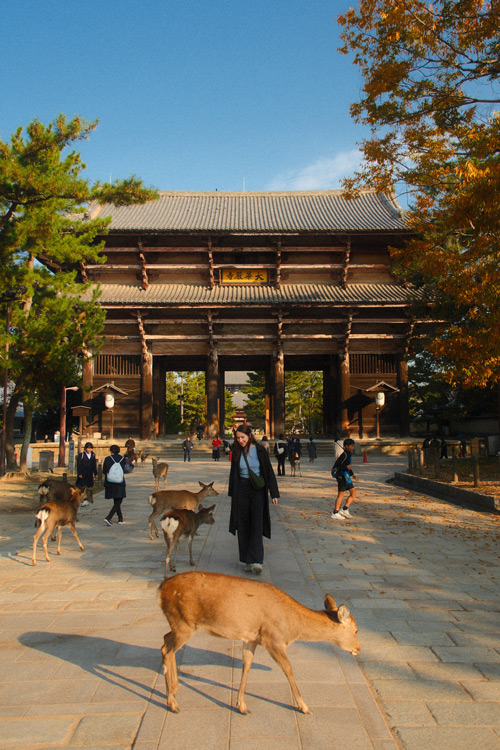
By the time you get to Nara Deer Park, you’ll probably already have encountered some sika deer walking around. Over 1,400 sika deer roam around the park freely, and it attracts a ton of tourists. In the park, you can find some stands selling packs of shika senbei, or deer crackers, to feed the deer. They cost around ¥200 and give you a chance to feed them.
Please don’t feed them anything else; you wouldn’t want them to get sick!
Funnily enough, the deer in Nara Deer Park have learned to bow to visitors. Bowing in Japanese culture is a form of showing respect, and many deer will return the favour. Give it a go while you’re at the park. Chances are, the deer will bow back to you. They may be begging for a deer cracker afterwards.
While they look adorable, please remember that these are wild animals. Yes, they’ve grown accustomed to the tourists and pose for pictures, but they can get aggressive. Please be mindful of these animals and treat them with respect. There have been many reports in recent years of tourists bothering the deer for Instagram photos or videos. The deer can be aggressive and attack, especially when crackers are involved.


4. Explore Kasuga Taisha Shrine
When you only have one day in Nara, Kasuga Taisha Shrine is a must-visit. It’s probably my favourite spot in the area. Not only does it fit perfectly on our walking route for the day, but it’s also one of the most beautiful shrines in the area.
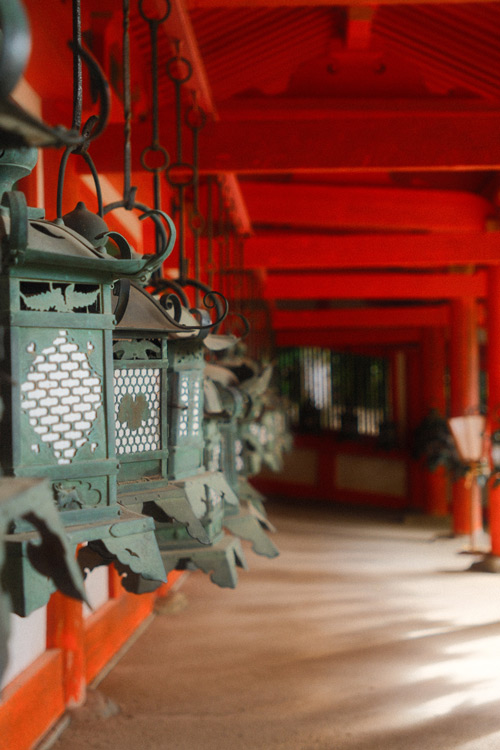
Kasuga-Taisha is one of Nara’s eight UNESCO World Heritage Sites and is famous for its lanterns. On the temple grounds, you can find over 2,000 stone lanterns and more than 1,000 hanging bronze lanterns.
A large section of this shrine can be visited for free. To go to the inner shrine, you’ll have to pay a small fee, which is very much worth it. I had skipped it myself on my first trip, but when I returned to Nara a few years later, the inner shrine was one of my favourite spots in Nara. It’s very much worth going into to see the hanging lanterns and more.


If you look closely, you can see that the hanging lanterns, you can see that none of them are the same. Every lantern that hangs in this shrine has been donated by people or families, and they were allowed to choose the design. It often reflects a family flower or has specific writing engraved. All lanterns start gold, but change due to the weather. You can spot some newer additions in the temple that are still gold.
A special ritual takes place at this shrine in February (Setsubun Mantoro) and August (Chugen Mantoro), where all lanterns are lit. The candles inside them are real and are lit by hand by the shrine staff. If you’re visiting during a different time of year, you can still see some of the lanterns lit up in a special dark room in the inner shrine.
The shrine was originally built in 768 but was rebuilt every 20 years until the end of the Edo Period. This 20-year timeframe was partly to maintain the building but also to hand down the techniques to the new generation.
While walking through the temple, you may also notice that you’re walking up a slight slope. This is because the shrine has been built on a sacred mountain, so they avoided digging into the mountain. Instead, they built around it. There are places to pray to the mountain, where a torii gate faces towards the mountain.
In the inner shrine, you can also spot a 1,000-year-old cider tree. Again, when looking at the building next to it, you can see that it was built around the tree without harming it.


Stay connected to the internet during your trip to Japan (essential for using apps like Google Maps & Translate!) with an eSIM. Journey Japan eSIM specialises in eSIMs in Japan, making them the best option for your next trip. (Read our full review here)
5. Stop for Udon at Mizuya Chaya
After exploring parts of the deer park and Kasuga Taisha, you’ve probably worked up a bit of appetite. Mizuya Chaya, a lovely little restaurant with a beautiful thatched roof, is located not far from the shrine. It makes for the perfect little pitstop before continuing our Nara itinerary.
When I stopped here on my latest visit, I was worried it might be busy due to the extra crowds entering Nara. It did look a little crowded when we showed up, but the queue moved quickly. Within 10 minutes, we were seated with our udon. While eating, I noticed the crowds slowly disappearing. There wasn’t even a queue left when we finished our food.
The udon was delicious and quite affordable. The cafe also accepts card payments, which is always a plus in Japan. There is a lot of outdoor seating, where you can enjoy views of the forest. Look out for the deer, they may try to steal your noodles!


6. Visit Todai-ji Temple & Daibutsu-san
The street that leads to Todai-ji is lined with shops and filled with deer begging tourists for crackers. This area can get quite crowded (another reason to stay in Nara overnight and visit Todai-ji in the morning, just look at the comparison in the photos below), so beware!
Walking up towards Todai-ji, you’ll first pass Nandaimon Gate (Grand South Gate). Being the largest wooden gate in the country, it’s no wonder it has left me in awe every time we visit. It was built in 1203 and still stands tall today. During my first visit to Nara, I thought this was Todai-ji due to its impressive size, only to be shocked to see the true size of Todai-ji just a bit further down the road!


Todai-ji Temple (Great Eastern Temple) is one of Nara’s most famous and most visited sights. Also listed as a UNESCO World Heritage site, Todai-ji was the world’s largest wooden structure until 1998 – it’s completely made out of wood. No nails were used. Its Great Buddha Hall houses one of the largest Daibutsu-san, or Bronze Buddha Statue, in the world. It reaches 49 meters in height!
The temple was established in 752, but has burned down a few times since. Despite this, it’s almost impossible to grasp the size of Todai-ji. The fact that this building is entirely made out of wood is incredible.
To enter Todai-ji and see the Bronze Buddha Statue up close, there is an entrance fee of ¥800. It’s worth getting the ticket, as the Daibutsu-san shouldn’t be missed when taking a day trip to Nara.


7. Wander Through Yoshikien & Isuien Garden
After Todai-ji, we finish this one-day Nara itinerary by paying a visit to the gardens of the city. Not far from Todai-ji, you can find both Isuien and Yoshikien Garden. They’re located pretty much next to each other.
Isuien Garden is the more popular garden to visit, but it does require you to pay a ¥1,200 entrance fee, which I find quite steep. Especially seeing that Yoshikien Gardens next door are free to visit for foreign visitors. The paid ticket also gives you access to the museum.
The garden’s name means “garden founded on water“, seeing that the garden is built on the Yoshikigawa River. It’s a very large garden, and you can easily spend an hour or so walking around and exploring the different routes. The front garden dates back to the 17th century, while the back garden was built in 1899. Inside the garden, you will find several tea houses.


Next to Isuien Garden, you can find Yoshikien Garden. This one is free to enter for foreign visitors and makes for a wonderful stroll. It was created in 1919 and is home to a pond garden, moss garden, tea ceremony garden and a traditional wooden tea house.
It’s definitely a lot smaller than the paid Isuein Garden, but it’s still incredibly beautiful. We visited it in autumn, and the foliage was beautiful! Yoshikien Garden is open until 5 pm (last entree at 4:30 pm), so it’s worth dropping by before heading back to the train station.
If you only have time to visit one of the two gardens, I would probably stick with the free Yoshikien Gardens.

8. Take the Train Back to Osaka/Kyoto
Most tourist attractions close quite early in Nara, usually around 4–5 pm. That’s why it’s so important to get here as early as possible if you only have one day to explore Nara. If you have some extra time left, it can be worth taking a stroll around Higashimuki Shopping Street and Mochiidone Shopping Arcade for some last-minute shopping.
You can now get this Nara itinerary (with walking route & map) as a downloadable PDF.
How to Get to Nara From Osaka or Kyoto
Nara is located close to both Kyoto and Osaka, so you can easily take a day trip from either city. Using public transport, you can get to Nara in under an hour.
Nara Day Trip from Kyoto by Train
Travelling from Kyoto to Nara can be done on the JR Nara Line or the Kintetsu Line. The best option for you will depend on what travel passes you have and how quickly you want to get there. Remember that you can always use Google Maps to see what options there are for you on the day you travel.
When using the JR Nara Line, you can either use the JR Nara Line Local or the JR Nara Line Miyakoji Rapid. Both services are covered with the JR Pass and will get you to JR Nara Station. This also includes some of the regional JR Passes, like the JR Kansai Wide Pass.
The local train takes around 70 minutes as it stops at all stations, whereas the Miyakoji Rapid only takes 45 minutes. They’re both the same price (¥720), so make sure you use the Miyakoji Rapid service as it’s much faster.
The Kintetsu line has two options: the Express (¥760), which takes 45 minutes and the Limited Express (¥1,280), which only takes 35 minutes. This service will take you to Kintetsu-Nara Station, which is a bit more centrally located compared to JR Nara Station. As this is a private line, it’s not covered by the JR Pass.
If you’re travelling to other areas nearby, it’s worth checking out the Kintetsu Rail Pass or the Kansai Railway Pass Lite. These passes are available for multiple days and cover a wide area. If you are planning more day trips in Kansai (Himeji, Kobe, Osaka, etc), it could save you some money.
Nara Day Trip from Osaka by Train
Visiting Nara for a day trip from Osaka is also possible. Two train lines connect Osaka with Nara: The JR Yamatoji Line and the Kintetsu Nara Line. The best option for you will depend on what travel passes you have and how quickly you want to get there. Remember that you can always use Google Maps to see what options there are for you on the day you travel.
You can use the JR Pass to travel to Nara when you use the JR Yamatoji Line. From Osaka Station, it takes 45 minutes and costs ¥820. You can also get on this train from Osaka Tennoji Station. From there, you’ll get to Nara in 30 minutes for ¥510. This line will take you to JR Nara Station.
The Kintetsu Nara Line has two options: the Express (¥680) takes around 35-40 minutes and the Limited Express (¥1,300) takes around 30 minutes. It will take you to Kintetsu-Nara Station, which sits in the middle of Nara, close to the deer park.
This line isn’t covered by the JR Pass, but you can use the Kintetsu Rail Pass or the Kansai Railway Pass Lite here. If you’re travelling to other places within Kansai, it could be worth checking whether one of these passes will save you money.

Since the price increase of the JR Pass in October 2023, it may not be worth getting the national pass anymore. Make sure to double-check your itinerary before purchasing it. It may be better to buy individual tickets, regional JR Passes or other regional passes like the Kintetsu Pass and Kansai Railway Pass Lite.
Is One Day Enough in Nara?
Visiting the main sights around Nara deer park can be done within a day, especially since Nara is easy to get to from Kyoto or Osaka. Following this itinerary will take approximately 6–7 hours.
However, Nara is more than just its deer park and surrounding areas! The prefecture has so much to offer, and the areas outside of the deer park are a lot less busy.
Especially since Nara deer park is getting a little crowded due to over-tourism, it can be a great idea to stay in Nara overnight to venture further into the prefecture. Below are some of my favourite spots in Nara Prefecture that you can add to your Nara itinerary when staying for longer than one day:
Other Areas in Nara Prefecture Worth Exploring
Here are some of my favourite other areas in Nara Prefecture to add to your itinerary:
- Horyu-ji Temple (30 minutes from Nara Station): One of the oldest temples in Japan, dating back to 607. The central gate, main hall and pagoda are the oldest surviving wooden structures in the world. When visiting, I was blown away by how beautiful it was. The pagoda is by far one of the most beautiful buildings I’ve ever seen. The temple grounds were also super quiet, which surprised me! Between the train station and the temple, you can also find all five Pokémon manhole covers in Nara Prefecture.
- Omiwa Shrine (30 minutes from Nara Station): While the exact date the shrine was built isn’t known, Omiwa Shrine is considered to be one of the oldest shrines in Japan. It’s a beautiful shrine located in the middle of a dense forest. The area between the nearest station and the shrine has lots of shops and restaurants.
- Asuka (one hour from Nara Station): South of Nara lies the official first capital of Japan, Asuka. Countless ancient tombs are scattered across the area, including the famous Takamatsuzuka tomb. You can hire a bike next to the train station and cycle through the historic town and rice fields. It makes for a perfect (half-)day in the countryside. You can check out my full guide to Asuka for more info.


- Mount Yoshino (one hour from Nara Station): If you’re visiting Nara during cherry blossom season, Mount Yoshino is one of the best places to go. The mountain has over 30,000 cherry trees. It’s also a beautiful spot to visit in Autumn when the leaves change colour.
- Imaicho Town (one hour from Nara Station): This well-preserved merchant town from the Edo period is part of Kashihara city, not far from Asuka. The district has tons of old houses and shops, and feels like stepping into a samurai movie. It’s easily combined with other areas nearby.
- Hasedera Temple (1.5 hours from Nara Station): Hasedera dates back to 686 and is often regarded as one of the most beautiful temples in the Prefecture. It goes by the nickname “temple of flowers” as it often displays colourful flowers. You can get some incredible views from the temple, especially during spring and autumn. There are lots of independent shops you can check out leading up to the temple, including a mochi shop that’s way less busy than the one in Nara city!
- Tsubosakadera Temple (1.5 hours from Nara Station): This temple is a unique one, due to its mix of Japanese and Indian styles. It dates back to 717, and you can find multiple Indian-style Buddha statues here. It’s mainly known for the large Buddha in the middle of the temple, which is especially beautiful during autumn with the red leaves surrounding it.


Where to Stay When Visiting Nara
If you’re visiting Nara on a day trip from Kyoto or Osaka, it’s best to stay at your hotel in that city. It’s easy to get to and from Nara from there, plus you won’t have to drag your suitcases on the train. We’ve got full guides on where to stay in Kyoto and Osaka, where we’ve broken down our favourite areas and hotels.
However, staying overnight in Nara is an excellent idea. Not only will you have a chance to see the main sights before the day trippers arrive (usually around 9–10 AM), but you can then also visit some other sights in Nara Prefecture that currently (surpringly) attract fewer crowds. Here are my top picks on where to stay in Nara:
- Budget – HARUYA Naramachi: After having stayed here for one night myself, I can really recommend it. Located in the more traditional Naramachi neighbourhood, this 100-year-old Japanese ryokan makes for a great spot to stay the night. There are Japanese-style rooms you can rent out, or opt for the private garden rooms.
- Mid-range – Iroha Grand Hotel Kintetsu Nara Ekimae: Located pretty much next to Kintetsu-Nara Station, this 4* hotel has a large selection of modern hotel rooms. They offer great value for the price, definitely one worth checking out.
- Luxury – Noborioji Hotel Nara: We got to stay in Noborioji Hotel for one night, and it was out of this world. The rooms, the service, the food, everything was top-notch. If you’re looking for a luxury stay in Nara, don’t look further than this one.
You could also consider staying a bit further out of Nara City, especially if you’re planning to add any of the other spots in Nara Prefecture to your itinerary.
For example, we also stayed in Candeo Nara in Kashihara City, which is around half an hour South by public transport. Staying here gives you easy access to other areas in Nara, depending on your itinerary. And the beautifully unique stay at Nara’s oldest soy sauce factory!
Conclusion – Is Nara Worth Visiting?
Nara is 100% worth visiting. Being the first permanent capital city of Japan, Nara is filled with history, beautiful temples, Japanese gardens and more. Of course, the deer are a big reason many people visit, but this is just a small part of what Nara has to offer.
I’ve included Nara in my two-week and three-week Japan itinerary for first-time visitors because of its historical importance and easy access from nearby cities like Kyoto and Osaka. Doing a day trip to Nara gives you enough time to loop around the main attractions in the city, too.
I do think that it’s worth seeing more than just the deer park. Nara Prefecture has so much to offer, and it’s a shame that so many people only come to see the deer and Todai-ji temple.
If your itinerary permits it, I would highly recommend staying overnight and adding a couple more sights in Nara Prefecture. You then also get the chance to see the deer in Nara in the morning before the bigger crowds arrive. The Prefecture truly deserves a bit of extra time to be explored. I, for one, can’t wait to go back and see more.







Thanks for all the great information. I so badly want to visit Japan. Hopefully next year!
Really hope you get to go! It was such a dream come true for me <3
Pretty bussy schedule, but I am sure it was worth it! I will keep your tips in mind, although it will take lots of time, till I get to Japan!
It was definitely worth it ^_^ Luckily, Nara isn’t too big so walking from one place to the other didn’t take too long 🙂 Hope you get to visit soon!
Ahhh looks like such an amazing day trip! Would love to visit Nara one day, the deer look sooo cuuute 😍 Love your blog btw ☺️
Thank you so much! 🙂 We really enjoyed visiting Nara, it was a nice little change from the busy cities haha!
I absolutely loved Nara, and also spent one full day there. 💕 it’s such an enchanting place.
Couldn’t agree more! So lovely 🙂
This is such a good post, I really enjoyed reading it! It’s interesting that it’s rude to eat on the trains in Japan, I eat on trains all the time in the U.K. without a second thought! And it’s so cute that the deers bowed back!
Yeah, I do the same! Especially during longer trips on the train, it’s quite common to eat on them in the UK – luckily I did a bit of research on Japanese etiquettes haha!
I’d never even heard of Nara before but now I can’t wait to visit when we go to Japan! The deer farm looks and sounds so cute too! X http://www.imjustagirl16.co.uk
Definitely try to go if you’re ever back in Japan – it’s such a lovely town!
Nara looks so beautiful, although knowing me I’d stay way too long feeding those cute deer!
Tori
Hahaha that’s so cute though! We definitely spent way too much money on those deer crackers haha, couldn’t resist!
This is such a neat looking place to visit! I would love to visit that deer park! Everything looks so beautiful!
It really is such a lovely place, people look after it so well! Hope you get to visit it someday 🙂
So glad you enjoyed the post! Definitely try to add Nara if you have a spare day in Osaka or Kyoto – it’s so cute!
I love looking at the temple and the architecture, there’s so much to learn about their history!! I’ve never been to Japan (yet) but I definitely want to go to the Nara deer Park. I didn’t know they could bow back, I think that’s so adorable!! 🤣 Thank you for sharing! xx
Geraldine
I couldn’t agree more, I absolutely loved learning about the history. It’s something that I really appreciate in Japan. There’s so much culture that dates back thousands of years, it’s almost impossible to grasp sometimes!
So much useful information here! I would love to go to the deer park if I ever get to go to Japan, they’re so cute! The architecture is so beautiful too. Amazing photos! I didn’t know that eating on a train is seen as disrespectful in Japan either, that’s definitely a handy tip x
If you ever get the chance to go, please do! Japan was probably my favourite destination every and I really want to go back next year ^^
The deer park looks amazing and all of the scenary looks so gorgeous! It’s great that you got to fit so much into one day as well
Kayleigh Zara 🌿 http://www.kayleighzaraa.com
Isn’t it just magical :D? We were really glad to find out that the city centre of Nara isn’ very big, so you can fit a lot into one day ^^
Amazing post, thank you so much for sharing, I have wanted to go to Japan for so long! It’s a dream destination of mine, there’s so many places to see – will definitely be booking a trip to Japan at some point <3
Chloe xx
http://www.chloechats.com
Thank you Chloe, so glad you enjoyed this itinerary! If you ever go to Japan, feel free to message me and I can help putting a plan together for you ^^
I’m so glad you learned about Nara in this post! If you ever go to Japan, definitely make sure to plan a little day-trip there. It’s so easy to get to from Kyoto or Osaka and definitely worth your time 🙂
Aww thank you! I really hope you get to visit Japan soon! If you need any help with planning your trip, feel free to message me 🙂
Thank you lovely! Nara was one of my favourite places, it really felt like “ancient Japan” if that makes sense. I kinda expected Kyoto to be like that more!
Wow this place looks absolutely stunning – definitely want to take my camera here one day…
It really is just beautiful! Especially during the autumn when the leaves change colours, it’s a dream destination for photographers! 😀
Wow, what a busy day! I have been to Japan but not to Nara I will have to put it on my list of places to visit next time I’m in Japan.
Japan is always a great option and I love going back. Nara is one of the most peaceful places in the country. and the people are nice too. The deer park with the cute deers was my favourite.
Such a good guide to the main sights in Nara! How long would you say this itinerary would take from the Kintetsu-Nara station? I’m thinking of making a half day trip to Nara from Osaka if I can get there early morning, but wanting to squeeze in as much as I can. I’m travelling myself so not planning to stop anywhere too long or for a sit down meal that day, so hoping I could see everything by mid-afternoon. Does that seem doable?
Hi Julie! That does sound doable – it may be best to skip a couple of the sights if you only have half a day (possibly skip Kasuga-Taisha) just to make sure you see as much as possible without having to rush too much 🙂
wow! This is really helpful! I’ll be in Osaka next week and until now, our iti is still finalize. This really help me ensure we can visit NARA efficiently. Thank you so much!
I did this exact itinerary today from JR Nara Station (East Gate) and it worked a treat! Had to speed run a few bits as time was limited (day trip from Osaka, returning there to catch Shinkansen to Tokyo), but we saw more than enough. And the deers really do bow!
So glad to hear this Steve! Hope you had a great time 🙂
We’re planning a day trip to Nara from Kyoto right now. We arrived in Nara around 11:30am. How many hours did this take you to hit all these stops with enough time to explore + take pictures?
You’d probably need around 5-6 hours for all of these, so that’s definitely doable 🙂
Had just a day to see Nara. Found this article and it was perfect! Definitely wear your walking shoes, it was a great and well thought out route. I got in at 10am as recommended and it was cold and rainy…not too crowded and i finished everything by 2pm…including a lunch stop at Mizuya Chaya which is on the way to the Kasuga Taisha shrine. Very small but delicious and friendly, don’t be intimidated! Thanks for the spot-on comprehensive day trip to Nara!
What an insightful information, thank you for sharing this with us. May you have a wonderful day 🤗
We just got back from Japan and have to thank you for your different itineraries. We followed your day trip itinerary to Nara & Kobe and it was perfect. We also used your itineraries for Osaka and Kyoto but were there longer. We loved Kyoto & Nara the best because they had a smaller town feel. We tried to get our Kobe beef at the restaurant that you recommended but needed reservations. There was another right next door (or upstairs) that was wonderful. Our trip was a great experience overall, so thanks again for all your great suggestions!
Debbie & Jeff
Going in a couple months and will be trying this!
is it good going to nara on sunday? or its too crowded?
You can expect crowds any day between 10am-4pm. If you want to avoid the crowds, I’d recommend staying overnight in Nara instead 🙂
Nele- Thank you! We are on the train back to Osaka from a fabulous day in Nara today. Your itinerary was perfection from beginning to end! It made for an easy day for us and a million thanks for doing what you do and obviously love. A few comments for whatever they are worth and many thanks once again:
– crawling through the big Buddha’s nostril was quite amusing.
– we stumbled upon the photographer, Irie Taichichi’s house and toured it for 200 yen each and it was delightful. Found it between the big Buddha and the gardens you recommend. A nice contrast from the huge scale of the shrines.
– the bakery down from your recommended coffee shop on the opposition side of the same street made for a delightful afternoon treat before heading back on the train.
All our best- Sharon and Jim from Oregon in the USA
So happy to hear you’ve had a great time in Nara! It’s such a lovely spot ^_^ Thanks for the extra tips, I’ll be sure to check out the bakery on my next visit!
Thanks for this super detailed Nara day trip guide, Nele! I really appreciated the walking route suggestions and the heads-up about the pagoda renovations—helps a lot with planning. The bit about the omikuji fortune-telling and the lucky spot in Nara was such a fun touch! Definitely bookmarking this for my upcoming trip.
Many thanks for this super itinerary.
I made the day trip from Osaka Namba Stn and followed your advice and suggested walking route.
I caught the 0900 train and spent the majority of my visit without large crowds until the end when thousands were still arriving in early afternoon despite the heat and humidity.
Getting there earlier made all the difference.
So glad you enjoyed the itinerary! Definitely the earlier you get there, the better! It can get quite busy during the day 🙁
Loved your very detailed itinerary, very useful for first timers…thanks so much. You mentioned luggage storage at the JR station. Is there one at the Kintetsu station as well ? So if we take a train from Osaka to Nara & after spending the daypack up the luggage & take the train to Kyoto will that work or is it too clunky carrying all our luggage ?
Thank you for your kind words! Yes, there is also luggage storage at Kintetsu Station, I’ll make sure to add it to the guide for more clarity 🙂
Thanks for the tip about Yoshikien Garden! Such a gem ❤️
A lot of people miss it! Such a nice area ^_^
Thank you for setting up this route – it helped us navigate easier and quicker. It was a great day, also thanks to you 🌸
So happy to hear you’ve had a great time! Nara is such a lovely spot ^_^