If you’re planning to spend two days in Nagasaki but are not quite sure where to start, we’ve got a fully planned itinerary for you! This 2-day Nagasaki itinerary will share an easy route through the city.
While most people will know Nagasaki, like Hiroshima, in relation to the devastating atomic bombing that happened here in 1945. This day has changed Nagasaki forever, but in the 80 years that have passed, Nagasaki has put a huge focus on world peace.
On top of that, Nagasaki has a very rich history dating back way before World War II. Along with its very friendly, almost village-like atmosphere, Nagasaki is home to lots of culture, history, a “10 million dollar view”, and fantastic food.
After having spent quite a bit of time in Nagasaki myself, I put together this 2-day itinerary to help you make the most of your visit. Here is how to spend two days in Nagasaki!


Nagasaki Itinerary Overview & Map
Nagasaki is very often skipped on people’s Japan itinerary, and it’s such a shame. The city has so much to offer, and was even highlighted in the New York Times best places to visit in 2026.
Nagasaki’s history as an important port town dates back centuries. It was the home of Portuguese missionaries creating a hub for Christianity in Japan, the place where Dutch and Chinese merchants traded with the Japanese during Japan’s isolation, and, of course, it was the last city to have been hit by an atomic bomb. This city has rebuilt itself into a thriving, multicultural town promoting world peace wherever possible.
Getting around Nagasaki is easiest done by the local trams or buses that connect all areas of the city. You can use your IC card (like Suica) or pay with cash. This Nagasaki itinerary will take you to some of the main sites across the city, along with a few lesser-known highlights that I personally really enjoyed visiting.
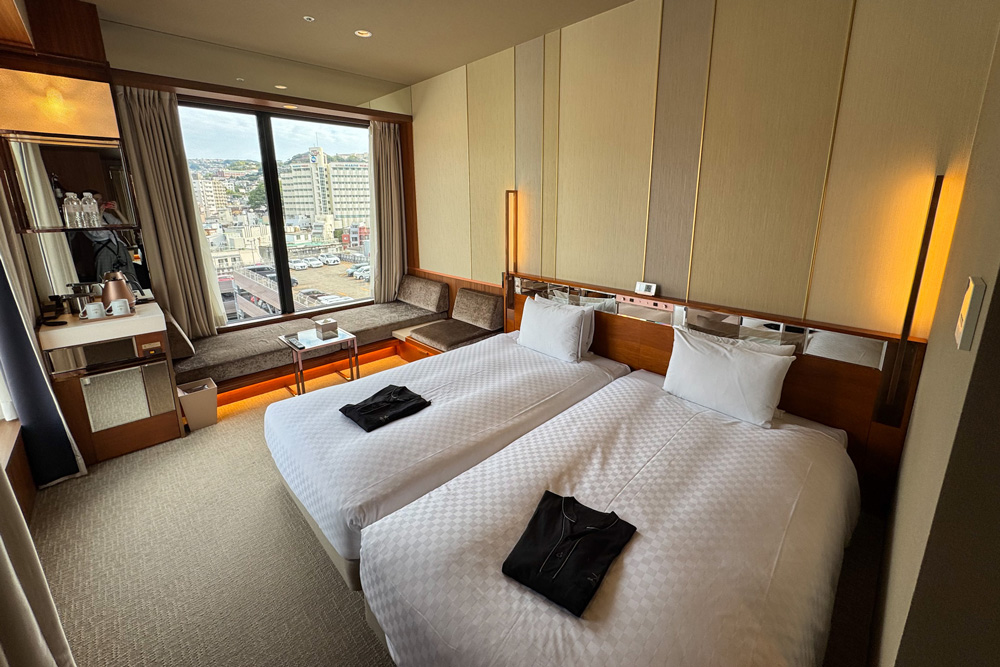
When choosing a hotel in Nagasaki, I recommend sticking to either the area around the “downtown” area near Chinatown or around the main train station. Below are hotels I personally enjoyed staying in and would recommend:
| Best For… | Hotel Name | Highlights | Book Now |
| First time visitors, easy access to main sights and comfort. | Candeo Hotels Nagasaki Shinchi Chinatown | Central location, great views, spacious rooms, comfortable beds and free rooftop public bath. | Check Availability |
| Value for money and central location. | Hotel Forza Nagasaki | Great location, comfortable rooms and affordable pricing. | Check Availability |
| Near station for easy access and day trips. | GRAND BASE Nagasaki Nakamachi | Modern, spacious rooms with great facilities (washing machine, for example) and next to the train station. | Check Availability |

I’ve put together an interactive Google Maps with all the spots mentioned in this itinerary for easy access while you’re in Nagasaki. Google Maps makes travelling through Japan much easier, so make sure you have a stable internet connection (usually through Pocket WiFi or an eSIM).
All the highlights of day one have been marked in pink, the second day is highlighted in dark blue, and I’ve added some additional recommendations in yellow (including some restaurants, cafes, hotels and tourist highlights that didn’t quite fit into the full itinerary). That way, you can really make this Nagasaki itinerary your own.


Stay connected to the internet during your trip to Japan (essential for using apps like Google Maps & Translate!) with an eSIM. Journey Japan eSIM specialises in eSIMs in Japan, making them the best option for your next trip. (Read our full review here)
2 Days in Nagasaki – Full Itinerary
Below, you can find my in-depth two-day Nagasaki itinerary, broken down into all the spots I recommend:
Day 1 – Peace Park & Mount Inasa
On our first day in Nagasaki, we mainly focus on the Peace Park and the surrounding areas, where we pay our respects to the victims of the atomic bombing that happened in 1945. We’ll end our day with one of the best night views in the world, atop Mount Inasa.
Nagasaki Atomic Bomb Museum
Three days after the first bombing in Hiroshima, the second and final atomic bomb was dropped on Nagasaki. Around tens of thousands were killed instantly, but the total number of deaths rose to over 100,000 in the following months due to the aftermath.
Visiting the Nagasaki Atomic Bomb Museum is an absolute must when in the city, making it our first stop on this itinerary. Not only to pay your respects to the victims of this horrible event, but also to learn more about what exactly happened and how we can avoid this from ever happening again.

Having visited both the museum in Nagasaki and the one in Hiroshima, it’s worth noting that the Hiroshima museum is much larger and left a bigger impression on me. It may be because it was the first of the two museums I visited, but I also think it’s partly because of the smaller size and collection of artefacts in Nagasaki.
Speaking with ShaSha Sonoda, who worked at the museum at the time, also revealed that Nagasaki has a slightly different view on what happened compared to Hiroshima. As Nagasaki was the last city to be bombed, they focus on the message of hope and peace. It ends with Nagasaki, and moving forward, we hope for peace. It made sense that the museum felt less intense compared to the one in Hiroshima.


I still think the museum is absolutely worth visiting. There is a lot of information about what happened leading up to the bombing, including how Nagasaki was actually the second choice. Kokura City was the main target, but because of thick clouds, the plane diverted to Nagasaki. A large part of the museum is dedicated to the aftermath and the future of nuclear weapons.
Similar to the museum in Hiroshima, the artefacts, including melted glass and burned stones, and photos of the survivors, are quite graphic. The videos of survivors’ testimonies left me in tears.
We spend around one to one and a half hours in the museum, before heading to the Peace Park. Entry only costs ¥200 for adults, ¥100 for children, and is open daily from 8:30 am to 5:30 pm.

Atomic Bomb Hypocenter Monument
After visiting the Nagasaki Atomic Bomb Museum, it’s time to head towards parts of Hypocenter Park. The Atomic Bomb Hypocenter Monument is not far from the museum entrance, making it a perfect next stop on this itinerary. In this park, you can also find the 50th anniversary memorial monument, created by Naoki Tominaga.
There are signs with more information about the monuments and that fatal day scattered across the park. I learned that the bomb exploded around 500 meters above the northern part of Nagasaki, where the Hypocenter Park is now located. Next to the Atomic Bomb Hypocenter Monument, you can also find the remains of the Urakami Cathedral. Next on this itinerary, we will visit the new Cathedral that was rebuilt in a different location.
If you walk down a set of stairs towards the river, you’ll find a well-preserved part of the park behind glass. You can see the rubble, roof tiles, burned sand and melted glass that were left as a result of the bombing. It’s an unsettling sight to stand right there, looking at the devastation.


Urakami Cathedral & Museum
We already passed the remains of the original Urakami Cathedral in the Hypocenter Park, but we’ll now visit the current cathedral that was rebuilt around 10 minutes from the original site.
The Urakami Cathedral was once the largest Roman Catholic church in the East. The large, red-brick building looks very European, which ties in perfectly with Nagasaki’s history as an important port town where many Portuguese sailors settled in the 16th century.
Even though Nagasaki was the centre of Christianity in Japan, its history is rather difficult. Christians were crucified here in the late 16th century, forcing other Christians to practice their faith in secret. The religion was banned for over 200 years, but Nagasaki remained strong. When the government changed its stance on Christianity in the 1850s, Nagasaki started building Oura Church and Urakami Cathedral.
However, when the atomic bomb was dropped on northern Nagasaki, large parts of the original cathedral were destroyed. Miraculously, a part of a wooden Virgin Mary statue (although damaged) and one of the bells were found in the rubble on Christmas Eve in 1945.
When the cathedral was rebuilt where it stands today, the statue and bell were brought here. When visiting, you can also go into the free museum next door, where you can learn more about the history of Christianity in Nagasaki and the cathedral.



If you want to learn more about Nagasaki’s history with Christianity, I also recommend making a stop at the Twenty-Six Martyrs Museum and Monument. 26 Christians were executed here while Christianity and missionaries were prohibited. In the museum, you can learn more about the martyrs.
Nagasaki Peace Park & Peace Statue
Nagasaki Peace Park sits just north of the hypocenter where the bomb hit the city. The park is a place to remember those who lost their lives, and it shares the message that something like what happened here should never be repeated. Throughout the park, you can find multiple statues and monuments.
The Peace Statue, created by Nagasaki-based artist Seibou Kitamura, holds up his right hand to the sky, representing the threat of atomic weapons. His left hand sits horizontally, wishing for peace. This is also the place where the Nagasaki Peace Ceremony is held every year on August 9th.


Hundreds of colourful paper cranes are also hanging near the Peace Statue. Similar to in Hiroshima, the paper cranes are a symbol of peace and remembering the horrible events that happened in these two cities. The cranes themselves were inspired by Sadako Sasaki, who folded 1,000 cranes while battling leukaemia after the bombing.
Not far from the Peace Statue, you can also find the Peace Fountain. The fountain was created in the shape of the wings of a dove, a symbol of peace, and the crane, referring to Nagasaki’s Port, sometimes being called “Crane Port”.
Another notable spot in the Peace Park is the Peace Bell, which was donated by the Nagasaki Hibakusha Certificates Friend Association. It was modelled after the bell from Urakami Cathedral and is rung every 9th of the month at 11:02 am.


Atomic Bomb Ruins of Shiroyama Elementary School
Surprisingly, I didn’t see this spot mentioned in many guides or itineraries, but it was one of the most interesting and moving places we visited on our first day in Nagasaki.
This school is located around 500 meters from the hypocenter. Parts were instantly destroyed by the impact of the bomb, while the second and third floors burned down in the aftermath. From the 1,500 students who were attending the school, it’s estimated that 1,400 didn’t survive.
The school was rebuilt in the years later, and a peace ceremony is held on the ninth of every month, promoting peace and remembering the victims of the bombing.


Parts of the original staircase were kept and opened to the public, along with artefacts, photos and information on what happened on August 9, 1945. It’s completely free to enter, and the staff is very happy to give you any additional information.
When we visited, we were the only people there. We were able to take our time walking up the stairs and reading the accounts of those who lived through the disaster. It felt strange standing on those stairs and seeing the photos, but it added a lot of value to our Nagasaki visit. If you don’t mind the small detour, I would highly recommend that you also visit it.


Sanno Shrine & The One-Legged Torii Gate
From Shiroyama Elementary School, it takes around 20 minutes to walk to Sanno Shrine and the one-legged torii gate. Depending on how much time you have left on your first day in Nagasaki, you can skip this part and head straight to Mount Inasa. However, this is a very interesting sight to see, especially after having learned a lot about what happened in Nagasaki in 1945.
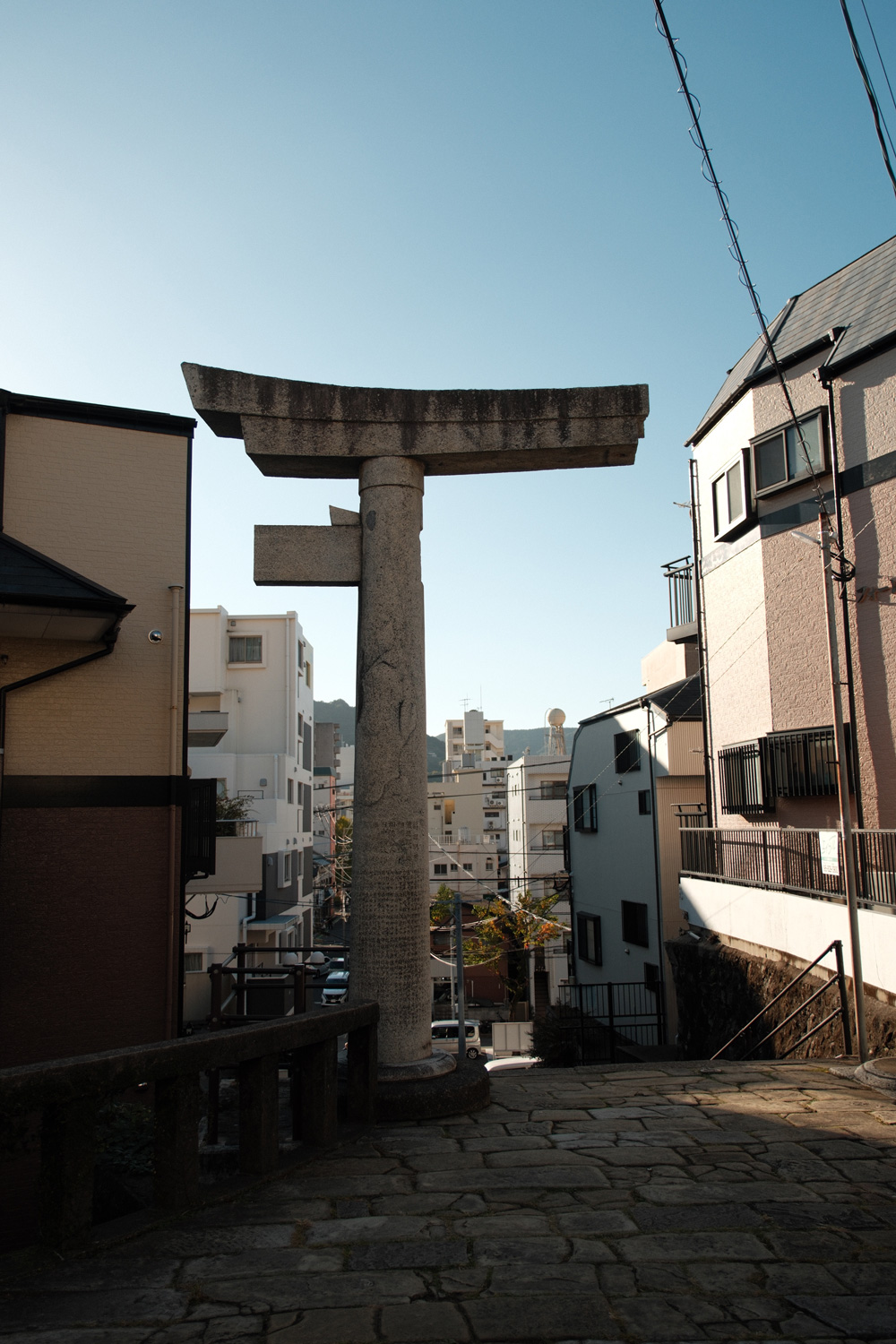
Originally, this gate was the second torii gate of Sanno Shrine. Even though the shrine is located around 800 meters from the hypocenter, it was almost completely destroyed by the bomb. The one thing that remained was one pillar of the torii gate, alongside half of the upper beam and two trees which were growing at the entrance of the shrine.
The one-legged torii gate was preserved as a National Monument. Walking towards the shrine after passing the gate, you’ll see the other half of the torii gate in pieces on the side of the road. It’s a chilling reminder of what happened here.

Enjoy Nagasaki Night View From Mount Inasa
To end our first day in Nagasaki, we’ll go to the top of Mount Inasa for one of the most beautiful night views in the world. Mount Inasa reaches 333 meters above sea level and sits just on the side of Nagasaki City. From the viewing platform, you can enjoy a 360-degree view of the city.
In 2021, this view was crowned as one of the best three night views in the world, alongside Shanghai and Monaco. You can see as far as Mount Unzen on a clear day from the observatory. This “10-million-dollar night view” is definitely worth adding to your itinerary.
The easiest way to get to the top is by riding the ropeway. You can buy a ticket and board it at the ropeway station at Fuchi Shrine. The ropeway runs every 15–20 minutes. As there is a 31-person capacity per run, make sure you get there with enough time to spare.
The best time to head up is about half an hour before sunset (you can check the sunset times for the day you plan to visit here). That gives you enough time to get up Mount Inasa and walk over to the viewpoints. A round trip costs ¥1,230 yen per person, and there are discounts for children or if you want to get a single trip.
The views are absolutely stunning, especially if you get there in time to watch the sun set and the city lights switch on. On my last visit, I saw a marriage proposal happening right at sunset! If you look down during your visit, you may be able to spot the illuminated heart in the floor too (there is only one, so you may have to search for it!).


Day 2 – Dejima & Glover Gardens
On our second day in Nagasaki, we will explore the central part of the city. With such a rich history dating back way further than the Second World War, Nagasaki has a lot left to be explored today.
Visit Suwa Shrine
The first stop on our second day in Nagasaki is Suwa Shrine. This beautiful Shinto Shrine is also home to the Nagasaki Kunchi Festival, a nearly 400-year-old festival held every October. As the shrine has been part of Nagasaki’s history for centuries, it has a complicated history. Nagasaki was a large hub for Christians in the 17th century, and Suwa Shrine was built in an attempt to stop Christianity from spreading further.
To get to the shrine, you will have to climb the 277 steps. Some tour guides recommend walking up in a zigzag motion to avoid vertigo. The views from the top are beautiful, so the walk up is definitely worth it.
At the entrance of the shrine, you can clearly see the large scratches on the ground from the Kunchi Festival. The large, heavy floats (often modelled after ships, reflecting Nagasaki’s multicultural heritage) that are part of the festival are pushed around on the ground and have left their mark over the last centuries.
If you happen to have any extra time in the evening, I recommend coming back for a lovely view from the top. Nagasaki sparkles in the night, and watching it from the quiet shrine is magical.


(Optional) Walk Along the Nakashima River Past Megane Bridge
From Suwa Shrine, it’s about a 30-minute walk to Dejima, the next stop on this itinerary. Depending on how much time you have (or how tired you are from the first day of exploring, you could take the tram or a taxi, but I would recommend grabbing a coffee and going for a stroll along the Nakashima River.
The river has around 20 beautiful bridges, including the famous Meganebashi (眼鏡橋, or “Spectacle Bridge”). It is said to be the oldest stone arch bridge in the whole of Japan, dating back to 1634. The double-arch, along with its reflection in the water, makes it look like a pair of glasses, hence the name.
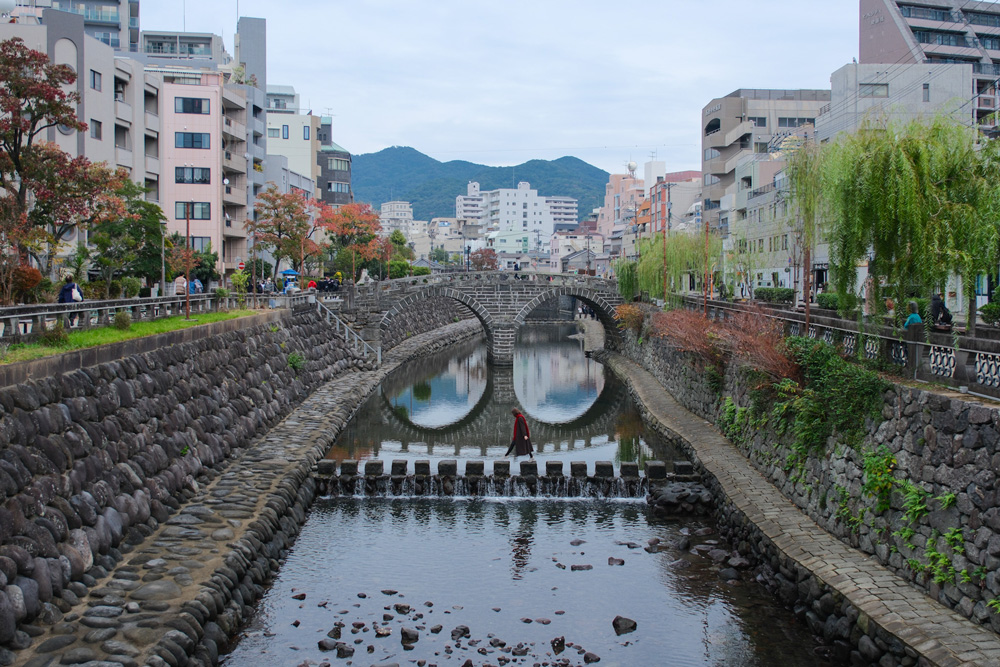
The bridge survived the atomic bombing but was damaged in floodwaters a few decades later. Luckily, it was restored with the original stones, so people can continue to enjoy it. There are some stepping stones in front of it, which make for a great photo spot.
The river itself is very clear, and you can often see koi fish swimming in it. On the side of the river, you can also spot a few heart-shaped stones (there seem to be a lot of hidden hearts across Nagasaki, if you remember the one at Mount Inasa’s observatory).
There are a lot of cafes and small restaurants located on the riverside too. Don’t forget to try the local Castella cake, influenced by the Portuguese settlers who once lived in Nagasaki. You’ll probably also find some people selling Chirin-Chirin ice cream on the riverbanks, which is shaped like the petals of a flower.

Step Back in Time in Dejima
Dejima (出島) is a man-made island near the port of Nagasaki. It was originally built to keep Portuguese settlers from spreading Christianity. It was later turned into a home for Dutch traders during Japan’s 200-year isolation (sakoku). Unlike the Portuguese, the Dutch weren’t interested in spreading religion in Japan; they wanted to trade.
No foreigners were allowed to enter Japan, including the Dutch. So instead, they could settle in Dejima and were strictly guarded. They were the only Westerners who were allowed to continue trading with Japan during this period.

As I’m Dutch myself, visiting Dejima was very high on my list of things to do in Nagasaki. When visiting, I saw a few other Dutch people visiting as well, and at the entrance, they even had an information brochure in Dutch (haven’t seen that anywhere in Japan!).
Dejima has gone through extensive restoration over the last few decades, allowing you to step back in time to see what life would’ve been like for the Dutch merchants. It’s very interesting to see the combination of the tatami-floored rooms with Western furniture placed upon them.
The museum is also worth visiting, where you can find displays of items that were found when excavating the Dutch Factory. Anything from rings, hairpins, dishes and toys is on display here. It’s a strange view, seeing so many Dutch references, like Delft and Maastricht ware.
Even for non-Dutch visitors, I think Dejima is a great spot to learn more about Nagasaki’s history and have a feel for what life would’ve been like here.


Stop by the Confucius Shrine
On our way to the next stop on this itinerary, Glover Garden, we stop by Nagasaki Confucius Shrine. Built in 1893 by the Qing Dynasty Government and the Chinese community living in Nagasaki, this is one of the only shrines dedicated to Confucius. On top of that, this is the only Chinese-style Confucius temple in Japan.
Inside the shrine, you can find 72 stone statues of his disciples, along with the Historical Museum of China. The shrine itself is beautifully decorated and gives you a glimpse into Chinese architecture and culture.
Especially as Nagasaki is one of the three cities in Japan with a Chinatown, visiting this shrine was a great addition to our day. It shows you more of Nagasaki’s history and multicultural makeup.


Visit Glover Garden & Ōura Cathedral
The walk up to the entrance of Glover Garden, called Glover Slope, is very touristy. Shops selling souvenirs, castellated cakes, and even things that feel incredibly out of place, like American license plates. I personally didn’t really enjoy this area, but Glover Garden itself was stunning and very interesting, so just keep walking!
Glover Gardens is essentially an open-air museum housing some foreign residential buildings, again, giving you a glimpse into the past of Nagasaki and its foreign merchants.


Glover House, the residence of the Scottish merchant Thomas Glover, is the oldest Western-style building in the country. Inside the house, you can learn more about Glover’s work, particularly the part he played in the Meiji Restoration and Japan’s industrialisation. You can also feed the koi in the pond in front of the house.
Multiple buildings across the gardens are worth a visit. You could easily spend a couple of hours here. It’s very interesting to see the mix of Japanese and Western architecture and furniture. It’s almost impossible to imagine what it would’ve been like to live here back in the 19th century.
From Glover Garden, you’ll get a lovely view of Nagasaki Harbour, where you may spot some of the cruise ships docking. If you are visiting Nagasaki as part of a cruise, visiting Glover Garden is a perfect start to your time here.

Near the end of your walk through Glover Garden, you’ll end up at the Nagasaki Traditional Performing Arts Museum. It’s free to enter as part of your visit to Glover Garden, and it’s worth a quick stop. Inside, you can learn more about Nagasaki’s Kunchi Festival and see some of the former boat-shaped floats.
Oura Church, possibly the most famous church in Japan, is located not far from Glover Garden, so it’s worth making a quick stop here while in the area. The church dates back to 1864 and is the first Western building to be named a national treasure in Japan. It’s a lovely building, but the entrance price is a bit steep (¥1,000 per person), and I didn’t think it was quite worth going inside.


While walking to Nagasaki Chinatown, you’ll pass Dutch Slope (オランダ坂). Depending on how much time you have left, it’s worth having a walk through it. When Japan opened up to foreigners again, the Dutch were able to move into Nagasaki from Dejima. The majority of them settled in the area that is now known as Dutch Slope. You can enjoy a walk through the cobbled streets, seeing some of the preserved houses.

Grab Dinner in Nagasaki Shinchi Chinatown
Japan has three major Chinatowns: in Kobe, Yokohama and Nagasaki. All three being important port towns in Japan, it makes sense that Chinese communities settled here. Nagasaki’s Chinatown, called Shinchi (meaning “new land”), was the place where Chinese merchants settled throughout Nagasaki’s history.
Music is played over speakers on the streets, and you can find some great dishes here, including Chanpon and Sara Udon. If you happen to visit Nagasaki during the Lunar New Year, visiting the Nagasaki Lantern Festival here is a must.


(Optional) Try Tomato-Based Ramen at Ramen Hiiragi
If you’d rather try something typical Nagasaki instead of grabbing dinner in Chinatown, just walk a little further and grab a seat at Ramen Hiiragi. Here, you can try the famous tomato-based ramen.
I’ll be honest, I was sceptical before trying it. I wasn’t sure how tomato was going to work with the traditional taste of ramen, and I wondered if it was a bit of a gimmick, but honestly, it was one of the best bowls of ramen I had during our trip through Kyushu. The rich broth works surprisingly well with the toppings, including the roasted aubergine. Delicious!
They also have a more standard bowl of ramen and gyoza, so you’ll have options in case the tomato broth doesn’t quite hit the spot.

How Many Days in Nagasaki is Enough?
When visiting Nagasaki, you’ll need at least two days to experience the city. Even this two-day Nagasaki itinerary is pretty stacked. You can easily add another day or two, especially if you want to use Nagasaki as a base for a couple of day trips.
Nagasaki Prefecture (and the rest of Northern Kyushu) has so much to offer, and it really deserves the time it takes to be properly explored. Day trips I can recommend include Huis Ten Bosch, Gunkanjima, Unzen Onsen, Shimabara, Arita, or even taking the Two Stars 4047 train from Nagasaki to Takeo Onsen.
Conclusion – Is Nagasaki Worth Visiting?
Nagasaki is one of the best places to visit in Kyushu, and it is definitely worth adding to your own itinerary. Comparing Nagasaki and Hiroshima is very difficult because the cities have such different and rich histories outside of the devastating bombing that happened in 1945. I think visiting both cities is a great idea.
When visiting Nagasaki, I would highly recommend adding some additional day trips in the Prefecture to your itinerary. There is a lot to see in Kyushu!