Hidden in one of the least visited prefectures, you can find the porcelain capitals of Japan, Arita and Imari. Over the last few centuries, these small, rural towns have influenced porcelain not just in Japan, but all across the world.
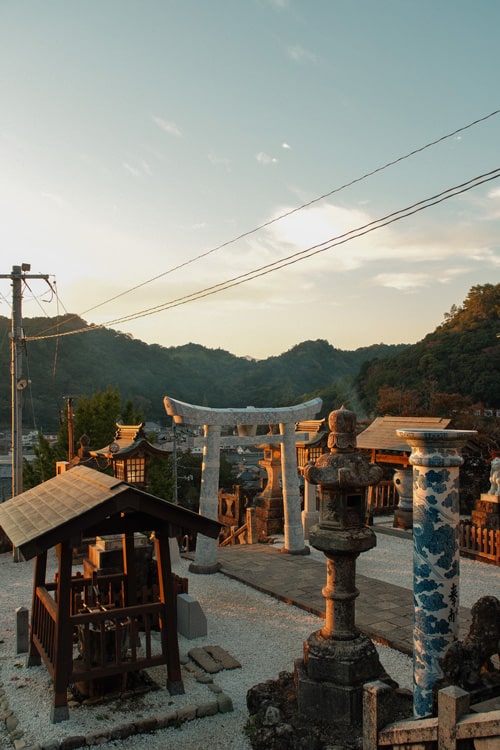
If you’re already planning to visit other, more popular spots in Northern Kyushu, like Fukuoka and Nagasaki, adding a stop in Arita is something I couldn’t recommend more. Even if you’re not really into pottery, this hidden, picturesque town is absolutely stunning and surprisingly quiet! You cannot miss the large, porcelain torii gate of Tozan Shrine.
Having stayed in both Imari and Arita for a few days while exploring the surrounding areas, I’ve put together this itinerary and travel guide to help you make the most of your visit.


Arita Overview & Map
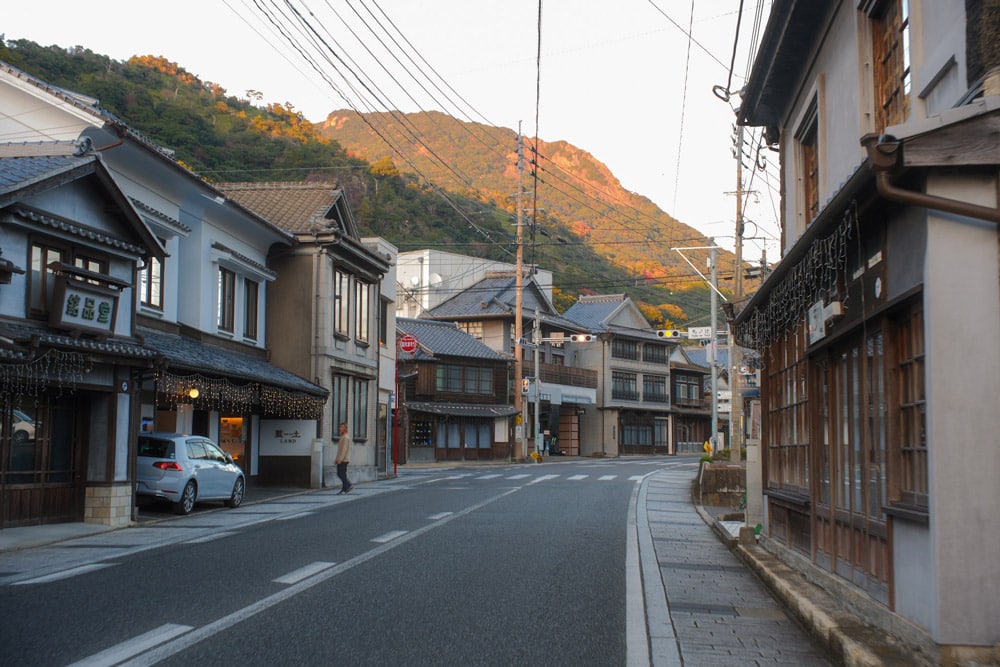
Arita is often skipped by tourists, and that is such a shame! The quiet, traditional town is beautiful and has some unique sights, like the porcelain torii gate of Tozan Shrine and the large quarry that supplied the ingredients for porcelain for decades. It’s a great addition to any Kyushu itinerary.
Nearby, you can find Imari, a small city that also ties in with the porcelain history. A lot of the porcelain made in these areas is known as Imari ware outside of Japan, as the port where the Dutch East India Company exported Arita ware all across the globe. Okawachiyama Village is another highlight nearby. This beautiful mountain village was kept a secret for decades as an attempt to hide the porcelain techniques.
When visiting this side of Saga Prefecture and you’re short on time, I’d recommend visiting Arita and Okawachiyama Village, skipping Imari. Arita is much more atmospheric and is more like a traditional Japanese town, whereas Imari feels more like a small, almost empty city.
The history of these places is quite interesting. Korean potters were brought over to Arita in the 16th century. It actually was a Korean potter who found the main ingredient for porcelain in the mountains of Arita, kickstarting centuries of porcelain production. The techniques and patterns used evolved over the years and were passed down from generation to generation.
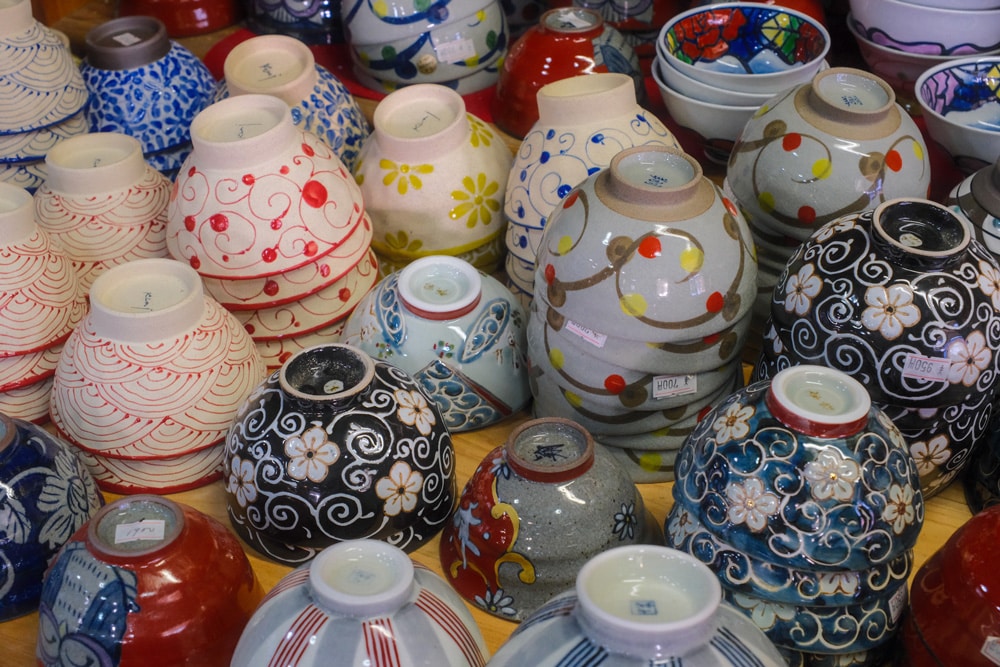
When the Dutch East India Company began trading Arita ware (or Imari ware) in the 17th century, the beautiful porcelain became so popular that even Chinese and European potters began copying it. I grew up in the Netherlands, and I never knew that the famous Dutch porcelain, like Delft Blue, was heavily inspired by the pottery created in Saga Prefecture.
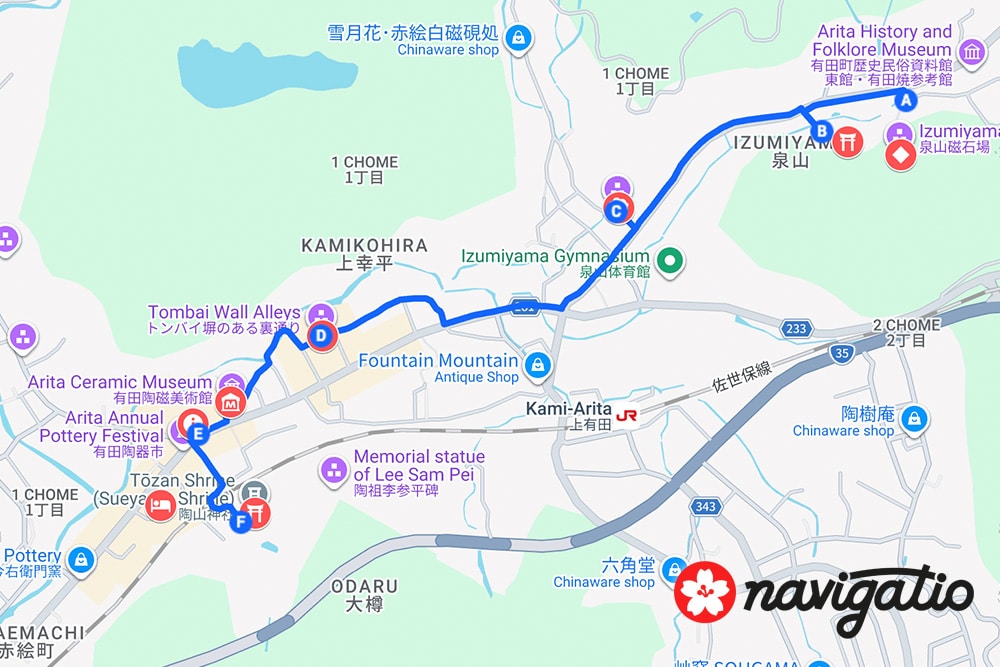
In this guide, I mainly focus on the Uchiyama area of Arita as the main sights are found here. The old traditional Japanese houses and kilns make for a very picturesque sight. You can follow this itinerary on public transport, but when travelling through rural Japan, it is much easier to have a rental car. You can take a day trip to Arita from nearby cities such as Saga, Fukuoka, or Nagasaki. Here is a map of the sights mentioned in this guide:
Can You Visit Arita & Okawachiyama in One Day?
Arita and Okawachiyama aren’t too far from each other, and as both towns aren’t exactly big, visiting both on the same day is very doable. As public transport isn’t very frequent in rural Japan, having a rental car will massively open up your options.
There are a couple of parking lots in Arita, and there is one large parking lot at the entrance of Okawachiyama. The drive between the two areas is around 20 minutes, so you could spend the morning in one of the towns before heading to the other in the afternoon.
If you rely on public transport, it will take much longer to get to Okawachiyama and Arita, and the trains/buses are quite infrequent. I suggest paying a little extra and using a taxi instead.
There are train stations in Arita (most of the sights in this itinerary are around Kami-Arita Station), but Okawachiyama is a bit harder to reach. You can take a train to Imari from Arita, and from Imari, there are buses to Okawachiyama, but they only go once every two hours… A taxi is much easier, especially if you’re short on time and only have one day to visit both.
You could use public transport to get to Arita from where you’re staying, and then use a taxi between the two towns. From Saga City, it takes around 40 minutes to get to Arita by train. From Fukuoka and Nagasaki, it takes around 1.5–2.5 hours, depending on which line you use.

Best Things to Do in Arita
When visiting Arita, here are the things you shouldn’t miss on your itinerary. I’ve listed them from further East to West, so you can simply follow the route and not miss any of the points of interest along the way.
Visit the Izumiyama Quarry
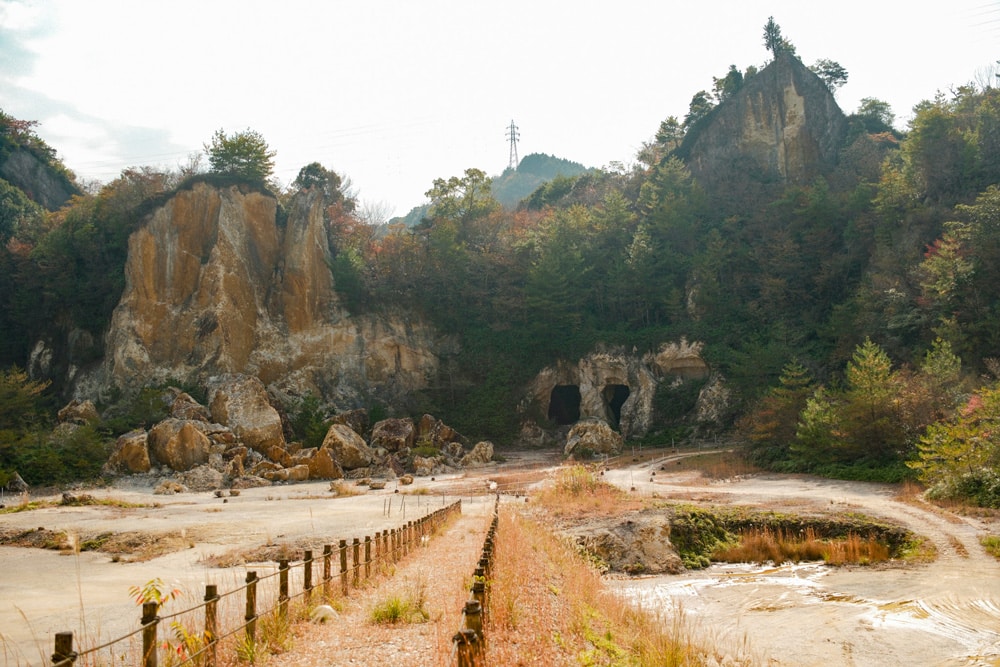
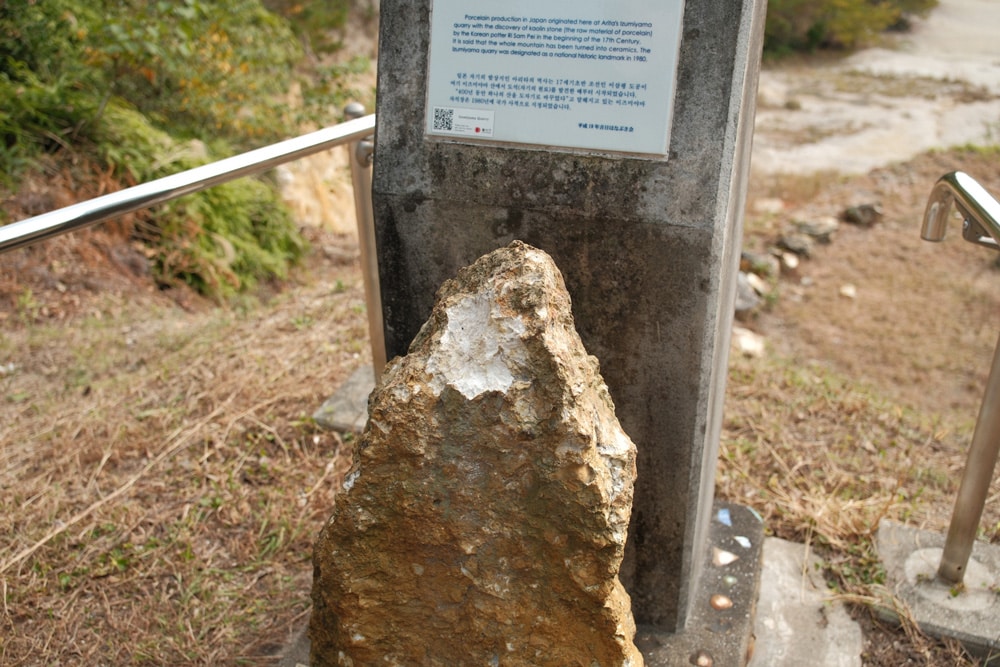
Arita’s history is intertwined with pottery. Porcelain in particular. And Izumiyama Quarry is where it all started. In 1616, a Korean potter named Yi Sam-pyeong discovered one of the main ingredients for porcelain in these mountains: kaolin (or kaolinite).
One of the information plaques near the quarry said that by 1897, over 10,000 tons of kaolin had been excavated from the quarry! Nowadays, the quarry isn’t used for mining anymore, and the porcelain manufacturers get their kaolin from Kumamoto Prefecture.
The quarry is very large, and it’s quite impressive to see it up close. Remembering how much this discovery changed not only the town but porcelain all across the world is incredible!
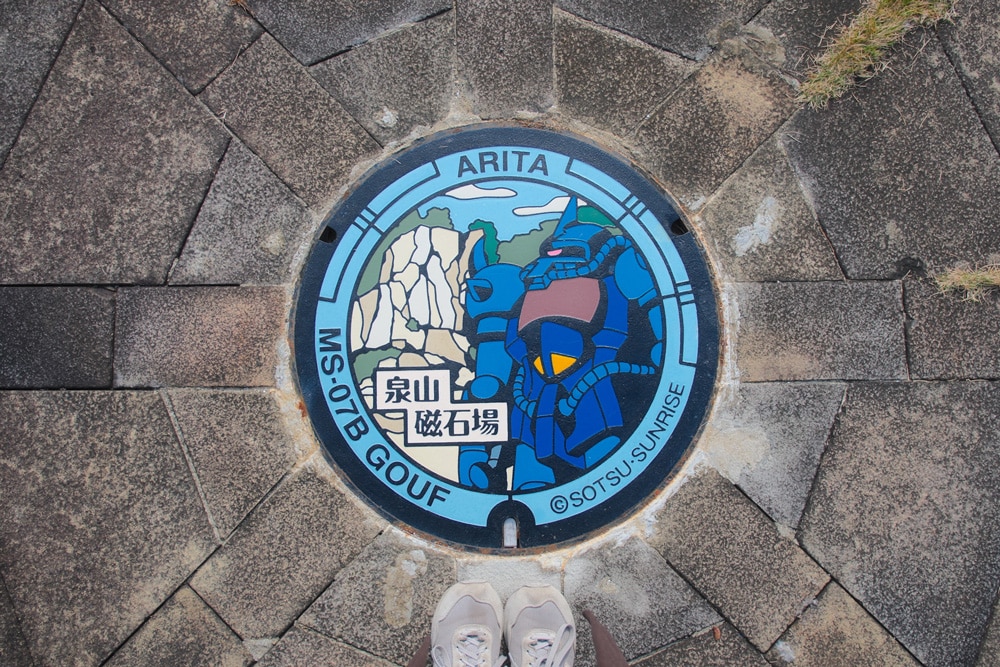
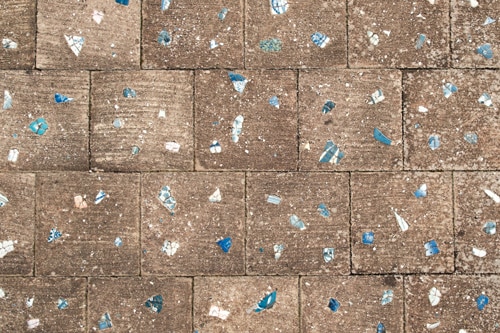
There are two large entrances to the mines visible from afar, and it feels a bit eerie. Pieces of broken porcelain are embedded in the pavement. There is a Gundam Manhole cover near the viewing point. A manhole cover card can be collected at the tourism information centre in town.
See the Father of Arita Porcelain at Ishiba Shrine
This small and slightly desolate shrine sits hidden in the forest near the quarry. Even though this shrine is nowhere near the most beautiful in the area, I think it’s worth a quick stop as it is part of Arita’s history. From what I can see online, most people skip it or don’t even know it’s there, which is such a shame.
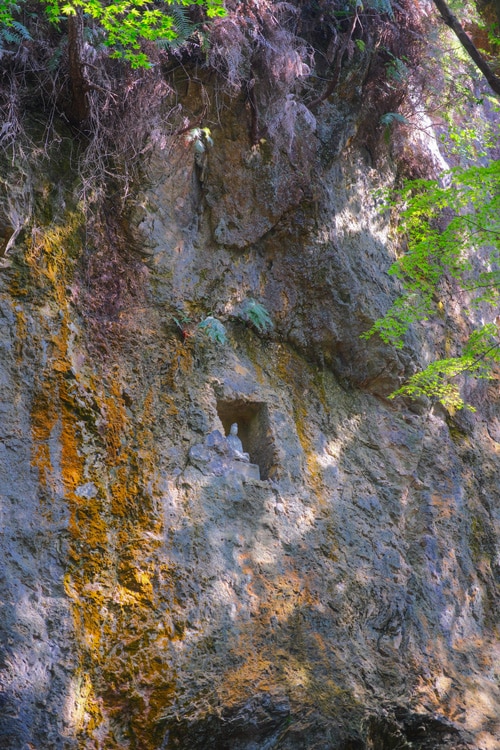
The area is quiet and peaceful, filled with beautifully red coloured leaves when we were there in November. The shrine is built against the wall of the quarry that supplied Arita with kaolin for hundreds of years. On the mountain wall, you can see some smaller statues hidden in tiny caves.
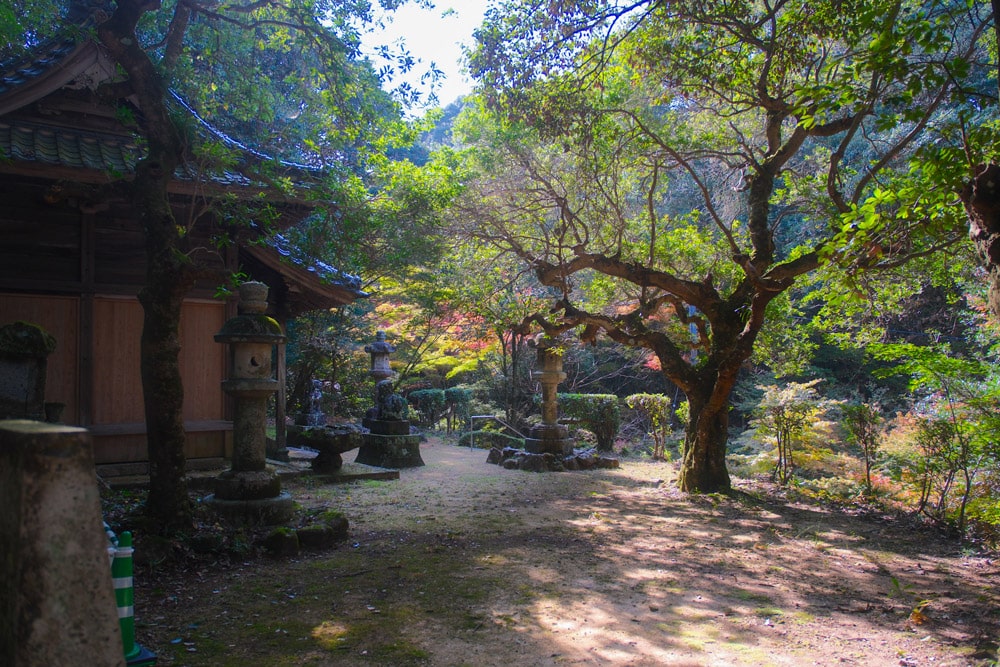
Korai-jin, or the God of Korai, is enshrined here, along with the smaller stone shrines in the area. The name Korai refers to how the Korean Peninsula was known in Japan back in the day, putting more emphasis on Arita’s ties with Korea.
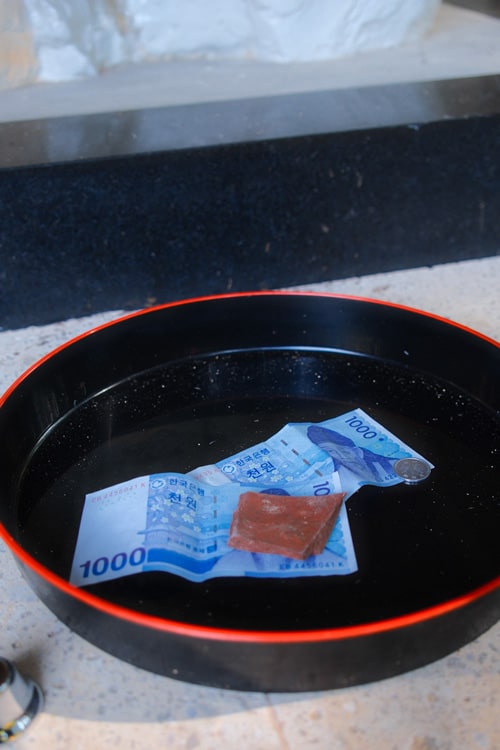
Seeing the white ceramic statue of Yi Sam-pyeong (also known as the “father of Arita porcelain”) that sits in the building next to the main shrine moved me a little. Especially seeing that someone had put some Korean money in front of him, a small token of his home.

See the Great Ginkgo Tree of Arita
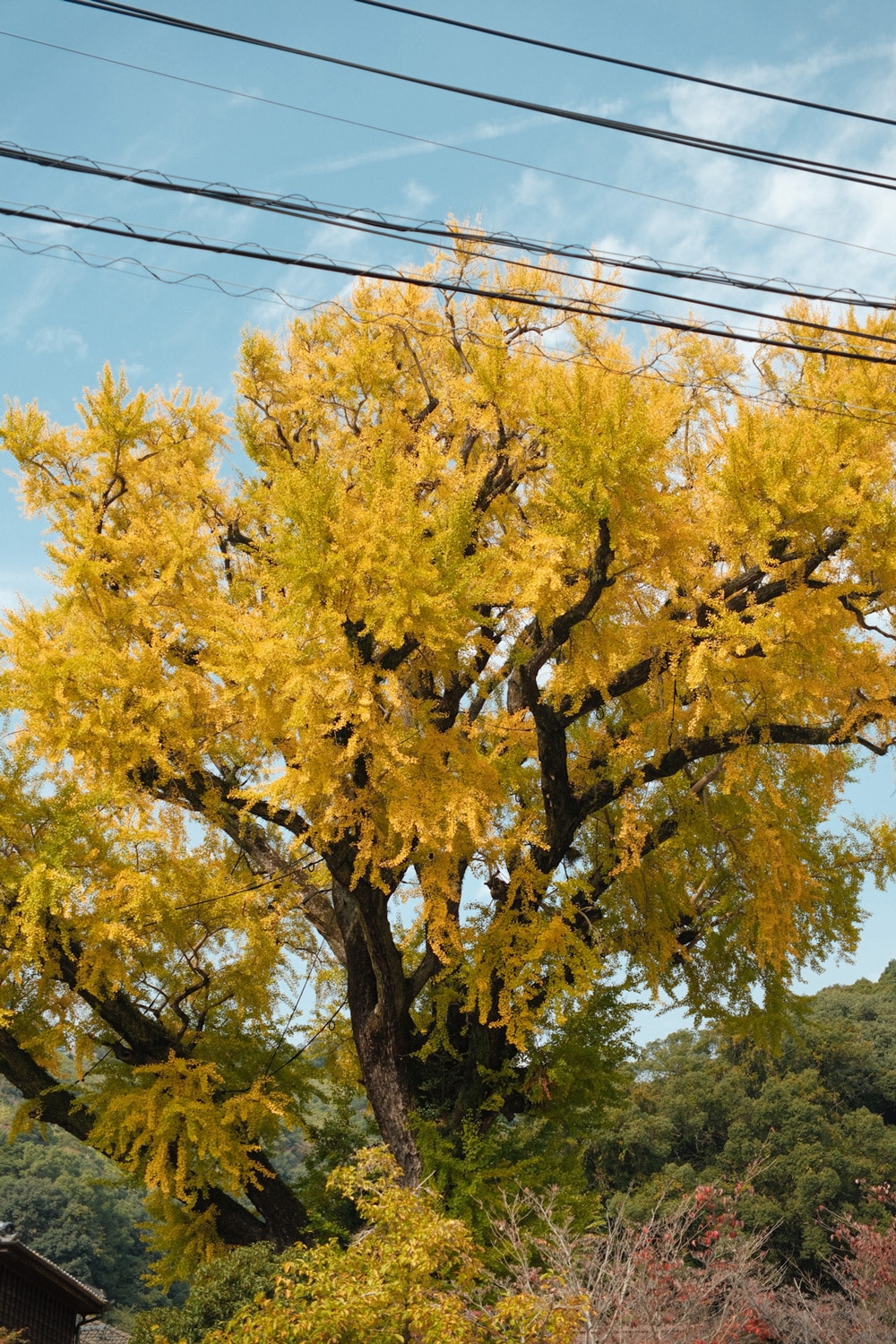
If you happen to visit in Autumn, you have to stop by the Ginkgo Tree of Arita. It’s hard to do it justice on a photo. Just outside of Izumiyama Benzaiten-jinja Shrine, this 40-meter-tall Ginkgo tree is one of the most beautiful trees I’ve ever come across (and I’ve seen some good trees in Japan!). Its size is incredibly impressive.
The tree is said to be over 1,000 years old and has watched Arita evolve over the centuries. In 1828, when a fire destroyed most of Arita town, the tree saved a nearby house. The tree didn’t catch fire, causing the winds to shift in a different direction, saving the house from being burned down.
Nearly a century later, in 1926, the tree was officially named a natural monument in Japan. If you happen to visit Arita in November, as we did, you’ll be rewarded by the bright yellow colours.
Walk by the Tombai Walls
Tombai, or tonbai (as it’s sometimes spelt), is the Japanese word for the fire brick used for the walls of the kilns. These walls date back to the Edo Period, and are made of the remains of fire bricks, fragments of porcelain, old tools that were used to make the porcelain and additional red clay.
These walls are mainly found in the Uchiyama area of Arita, connecting the backstreets and porcelain shops. Following the walls to the alleyways is a great way to see some more of this small town and find some more great pottery deals.
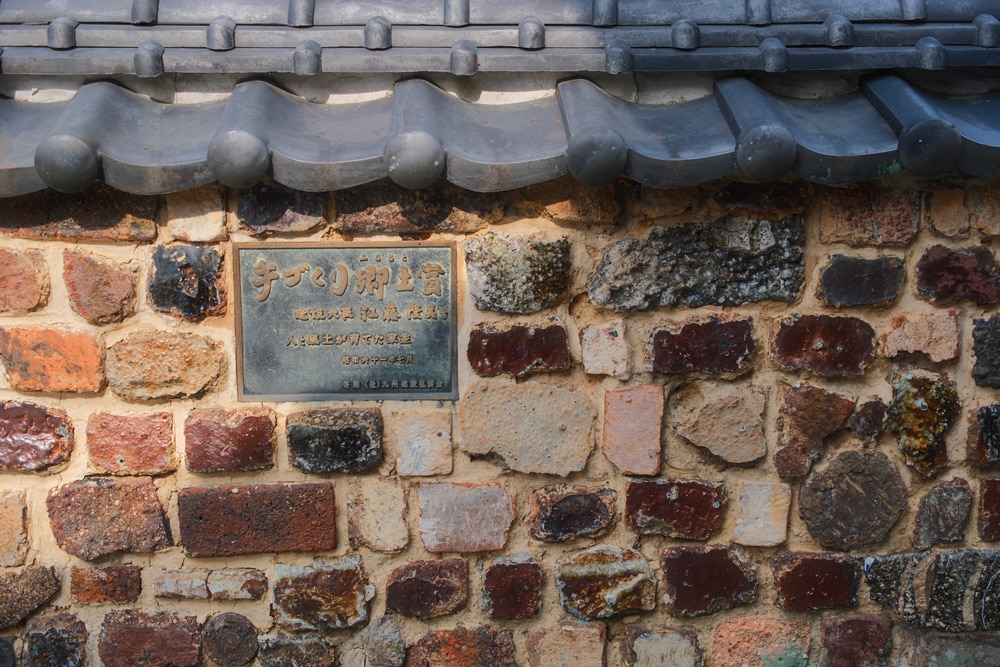
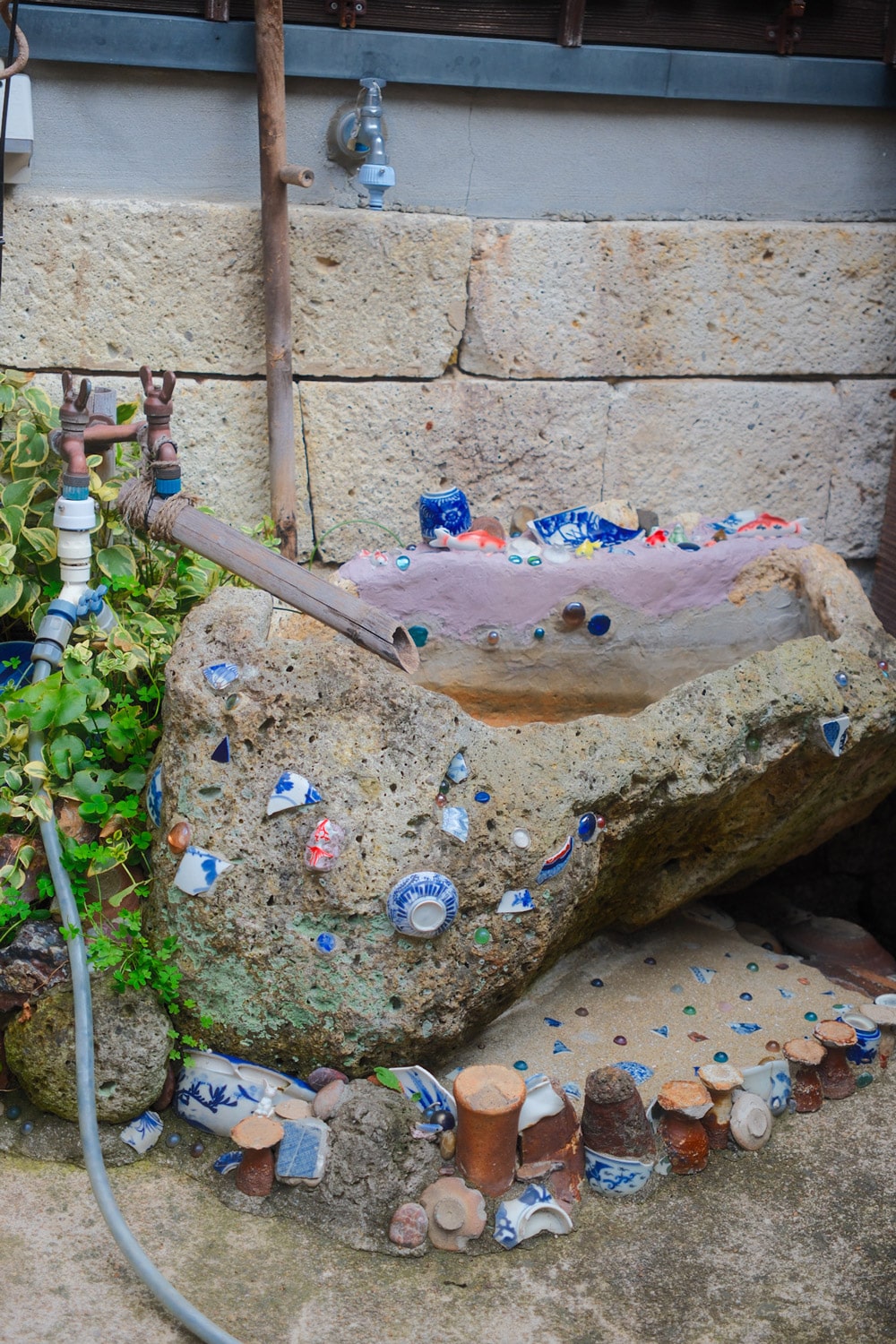
Fragments of porcelain can be seen all across the town, in the pavement, walls, and even as part of a little water fountain I found in one of the back alleys. It’s so unique to see parts of Arita’s ceramics literally being embedded in the heart and soul of the town. The colourful pieces stand out everywhere.
Visit Tōzan Shrine (Porcelain Torii Gate)
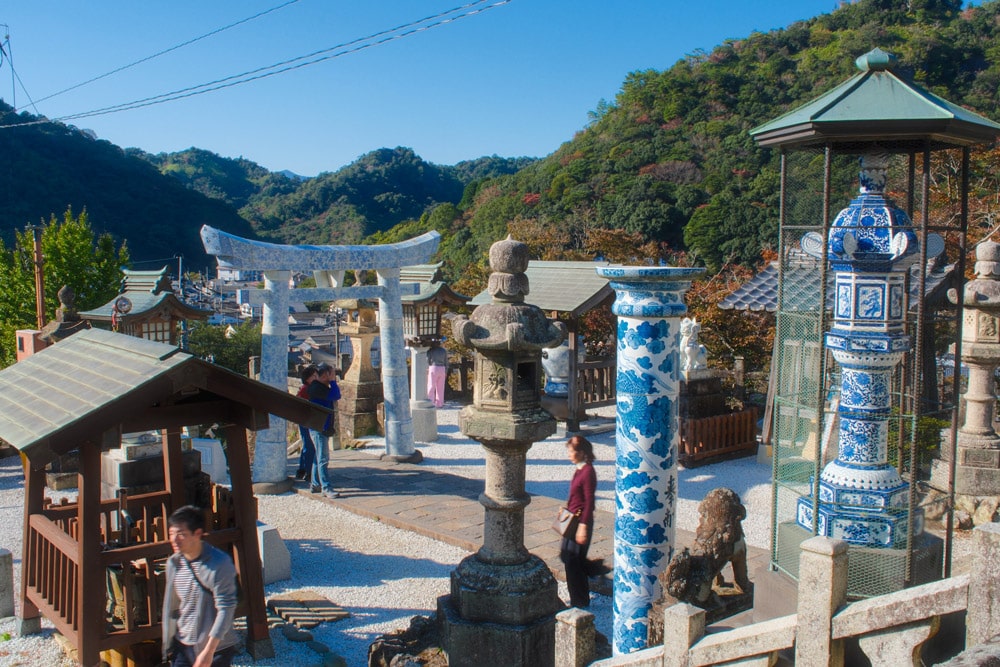
Possibly the most popular and famous sight in Arita is Tōzan Shrine, mainly due to its gorgeous porcelain torii gate. A one-of-a-kind, and one perfectly unique to the town.
The shrine dates back to 1658, when it was founded under the name Sueyama Jinja. The nickname Tōzan came into the picture during the Meiji period. It roughly translates to “pottery producing area”, a fitting name. It is dedicated to Emperor Ojin, Yi Sam-pyeong (the father of Arita Porcelain) and the Nabeshima Naoshige clan (previous lords of the Saga domain).
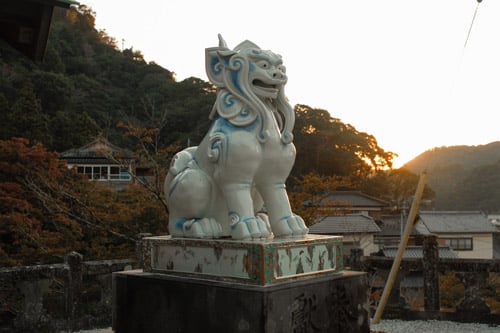
Multiple parts of the shrine are made of porcelain, not just the torii gate. There are some pillars, vases and lion statues all made of Arita’s famous white-and-blue porcelain. Apart from cherry trees, there are some altheas planted around the shrine. This is the national flower of Korea, a small token of appreciation for the Korean potters who helped build Arita and its ceramics history.
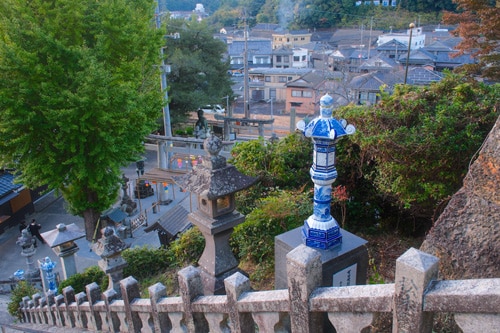
The shrine shop sells unique souvenirs, tying in with what the town is most famous for. The usual ema plaques and omamori that you can usually get at shrines are also available here, but instead of wood and fabric, they are made of Arita porcelain.
If you keep walking up the mountain after visiting the shrine, you’ll find a monument dedicated to Yi Sam-pyeong. It was built in 1917 to celebrate the 300th anniversary of Arita porcelain and rewards you with a beautiful view of the quaint town.
During our stay, we stayed in a only a couple of minutes from Tōzan Shrine. This way, we got to see it a few times, but it was definitely most beautiful during one of our evening walks when the sun started to set.

Shopping for Ceramics & Porcelain
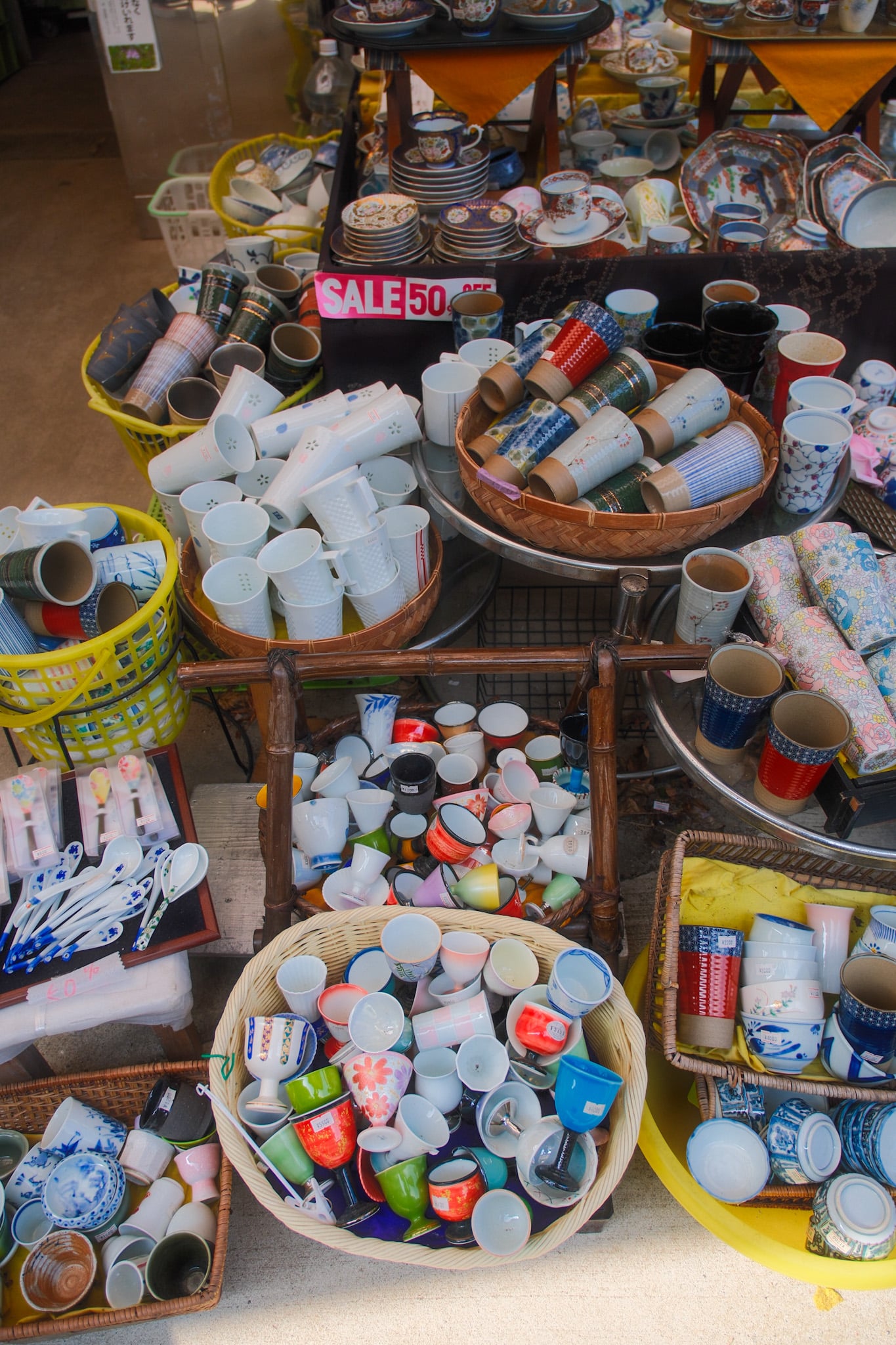
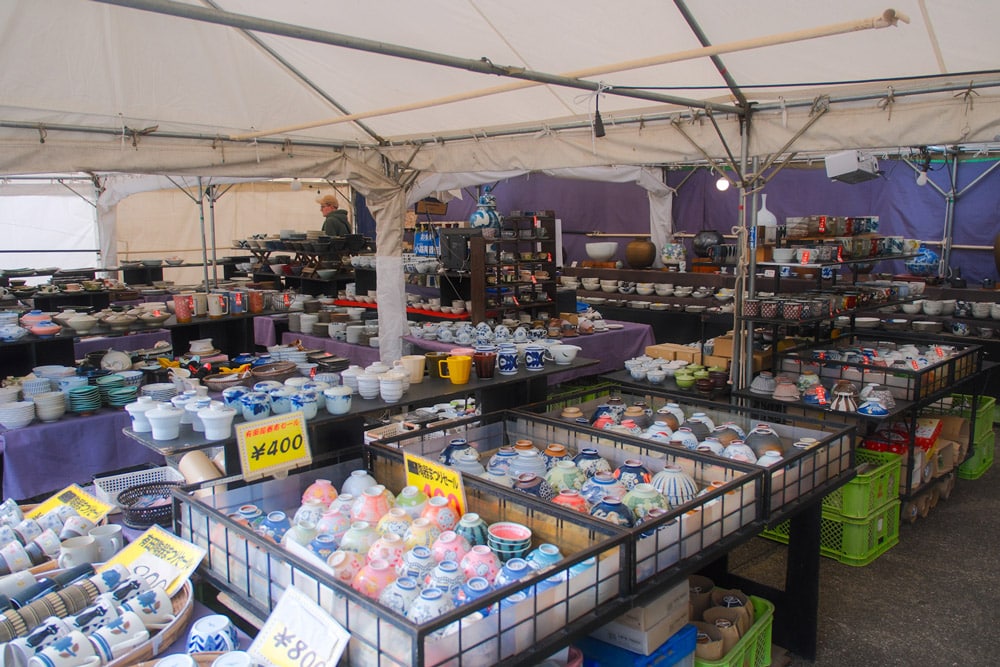
What better place to buy authentic Japanese porcelain than in Arita itself? There are many operational kilns in the town with shopfronts, selling their creations for very reasonable prices. You can really make it as expensive as you like.
The Arita Ceramics Fair is held twice a year, once during Golden Week and once in the autumn, and brings hundreds of stalls and sellers to the town. During this event, it’s probably the busiest it gets in Arita! But luckily, you don’t have to visit during the Ceramics Fair to buy porcelain here.
On regular days, there are more than enough spots open for selling their pottery. A short walk through the town, and you’ll mainly see pottery stores. Most stores have full-priced items in the shop, but often have “outlet” or “discount” items for a few hundred yen.
More high-quality, artisan pieces can go up to thousands of yen. The best way to shop for them is to know what types of items you’re looking for and set a budget on how much you’re willing to spend. There are thousands of items per store, so take your time wandering around. If you are also visiting Okawachiyama, keep in mind that there are more pottery shops there.
Can You Bring Ceramics Home in a Suitcase?
If you’re worried about bringing home pottery in your suitcase without it breaking, you’re not the only one.
Luckily, if you buy anything in Arita, they will wrap the items very securely in paper and bubble wrap. If you then also make sure you wrap some of your clothes around them and put them in your suitcase so they don’t have a lot of room to move/smash, you should be absolutely fine!
I’ve taken pottery back from Japan multiple times (most of my cups at home were bought in Kappabashi in Tokyo), and they’ve always made it back without any damage.

If you want to find some cheaper Imari or Arita ware, it’s worth driving to a secondhand store (like Book Off or Second Street) in nearby towns/cities. I saw SO much porcelain in Sasebo’s thrift stores, and all for very reasonable prices and in perfect condition.
Porcelain Treasure Hunt at Kouraku Kiln
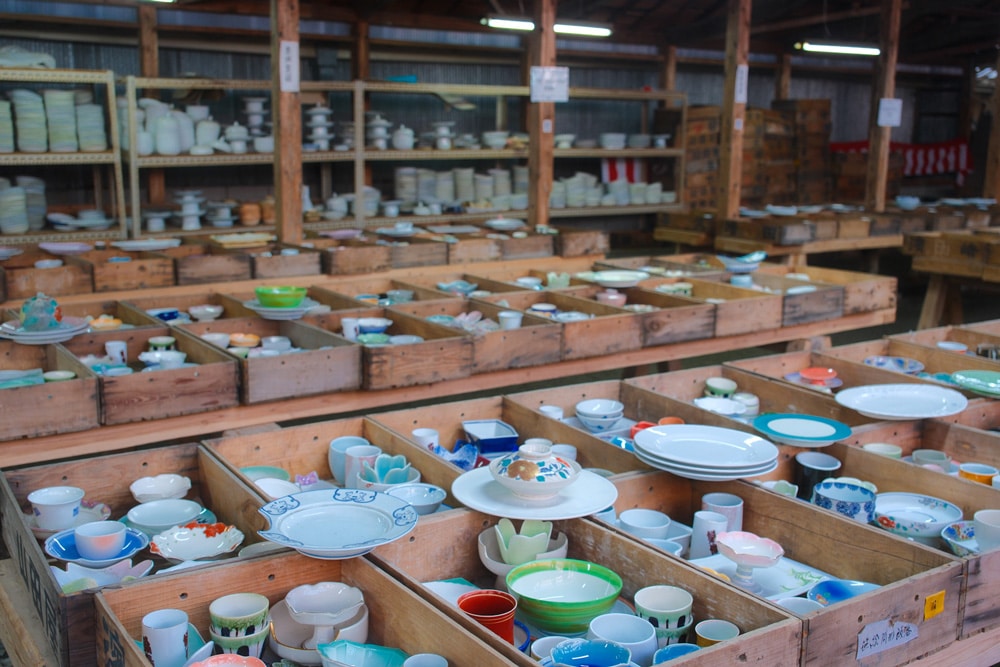
One of the most “famous” spots to buy porcelain, especially on social media, is the Kouraku Kiln in Arita. This 150-year-old kiln has opened up its warehouse, where visitors can go “treasure hunting” in boxes and boxes of unsold pottery. For a set price, you can fill a whole basket with as much pottery as possible, creating your own little collection to take home. Despite being very excited to visit, I was quite disappointed by it.
There are two price tiers: ¥6,600 for the “cheaper” course, which includes pottery that isn’t as colourful, and the ¥13,200 course that gives you access to all the pottery available in the warehouse. Once decided on the course, you get 90 minutes to sift through the boxes and fill your basket. It’s not a small basket either, so it’s not bad value for money. It was also incredibly dirty, with gloves available at the entrance because the pottery was covered in dust and dead insects.
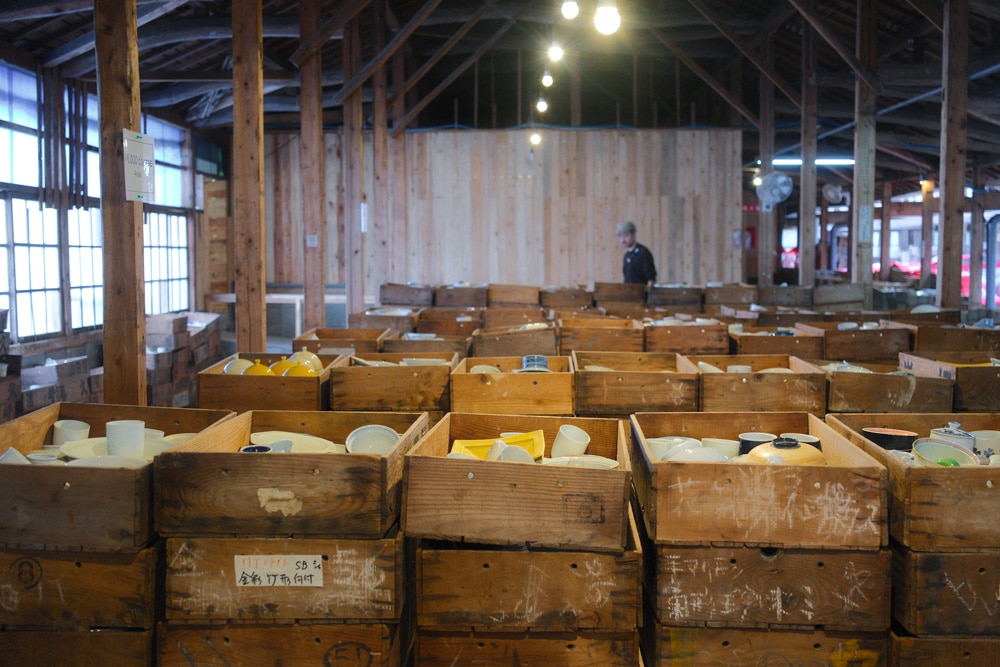
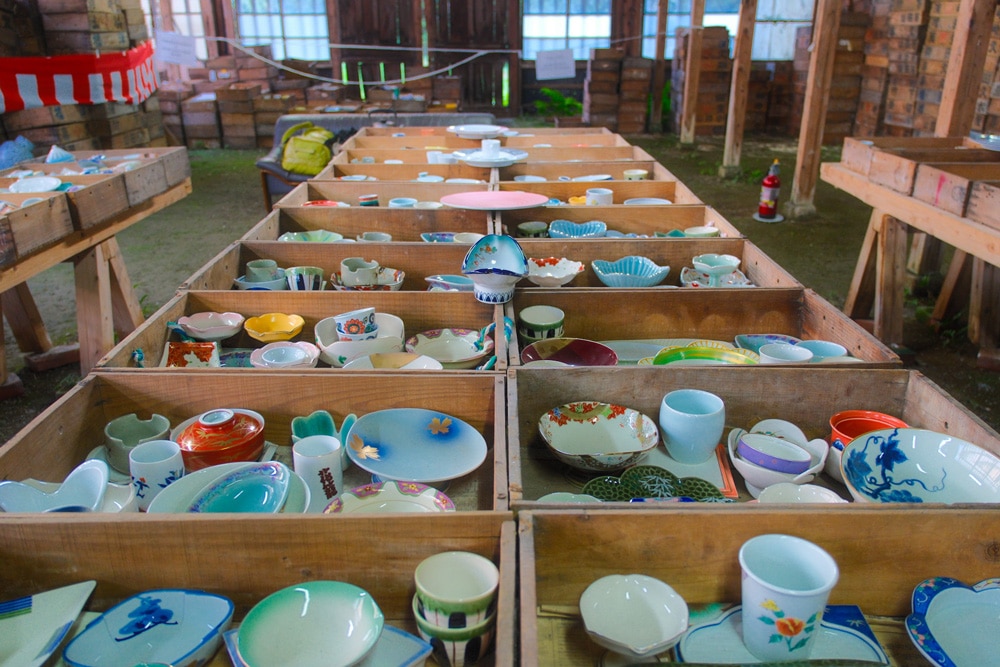
In the 10 minutes you get to quickly scout the rooms before committing to one of the courses, I only saw one or two pieces I’d actually wanted to take home. Most of what I saw was very similar and plain, and it seemed that many of the real treasures had already been scooped up by other visitors. Instead of just getting a basket for the sake of it (or for the “content”), I decided to give it a miss.
Especially knowing that the whole town of Arita is filled with pottery shops, I thought it would be better to buy a few individual pieces I know I’ll love and use, instead of trying to fill a basket for the experience. Many shops in Arita have a small outlet or discount section. I came across many cups and bowls for around ¥300. There are, of course, more expensive pieces, like a cup I loved for ¥2,200. Still, I’m very happy I chose this option over the treasure hunt.
The place has a lot of great reviews online, so maybe I’m being a bit too harsh, or maybe I didn’t look hard enough for good pieces. I’m not saying “don’t go”, but I would keep in mind that it seemed a little too hyped up online.

If you are planning to visit Kourku Kiln (or if you have a car and don’t mind taking a little drive out of Arita centre), I also recommend stopping by Arita Sera as it’s not too far. There are some great porcelain shops here, and a fantastic bakery called Marubun. We went to this bakery almost daily when we stayed in Arita. It was great!
Should You Stay Overnight in Arita?
Kyushu has a lot of amazing places to visit, and staying overnight in a quiet, picturesque town like Arita is something I would highly recommend if you have a rental car for your trip. It also obviously depends on the rest of your itinerary and your preferences, but I loved staying overnight in Arita.
If you’re using public transport, it’s usually better to have a few “home bases” in bigger cities like Nagasaki or Fukuoka, so you can leave your luggage there and take day trips to more rural spots like Arita. Dragging your luggage on public transport in rural Japan is not great, as it wastes a lot of time and energy (not to mention the infrequent trains and buses). With a car, you can leave your luggage in the booth while exploring, and you can take out what you need during your overnight stay.


There aren’t a lot of options when it comes to staying overnight in Arita. We ended up staying in ZOKU IJINKAN Guest House for a few nights, and it was fantastic. The traditional guest house was located in the middle of the town, but quietly hidden on one of the back streets. It is owned by local artist Shin, who also runs one of the galleries in town.
Despite being one of the cheaper places we stayed at in Kyushu, it was one of the most memorable. The guest house came with a small kitchen and living space, a dedicated parking spot, a tatami floor bedroom where thick, fluffy futons were set up for us, and a gorgeous inner garden with a koi pond. It really felt like we got to live in Arita for a few days. There were bikes available, too, if we wanted to explore the town by bike.
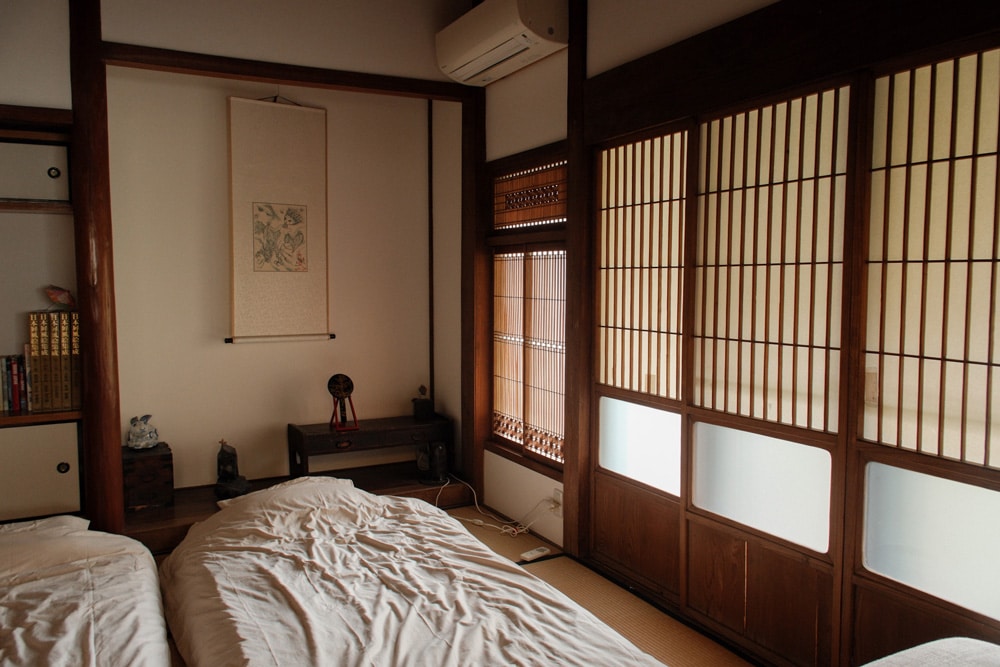
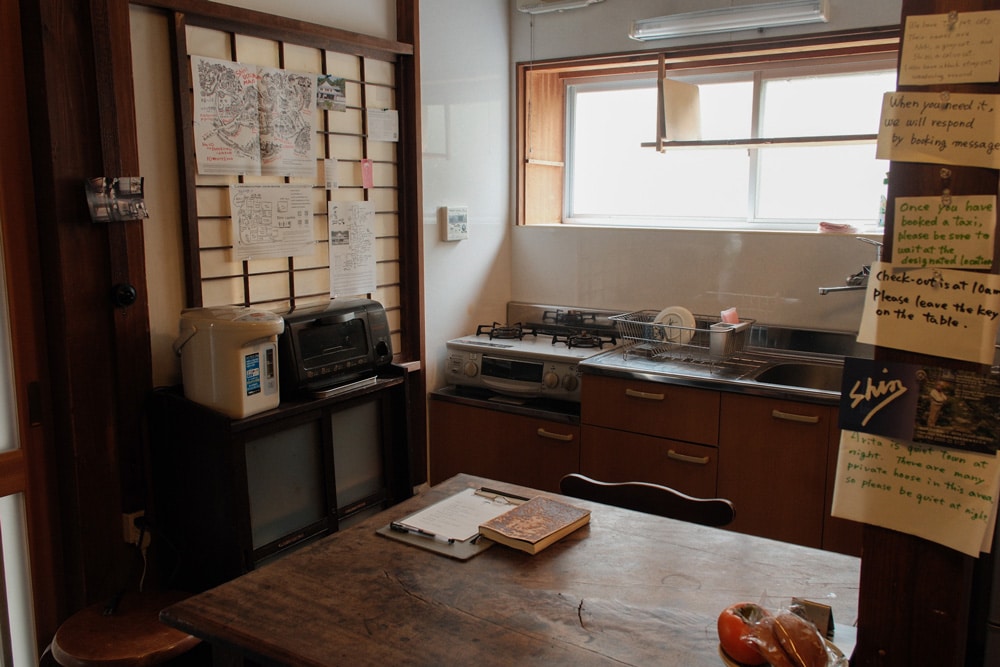
As the house was only a couple of minutes’ walk away from Tozan Shrine, we got to visit it a couple of times on our evening walks and got to enjoy the sunset colours wash over the porcelain torii gate before heading “home”. It was a magical few days, and staying in such a beautiful traditional townhouse added that sparkle.
Is Imari Also Worth Visiting?
Personally, I wouldn’t recommend Imari City. However, Okawachiyama Village, which is technically part of Imari, is definitely worth visiting. You can combine a visit to this hidden village with Arita quite easily, especially if you have a rental car (or don’t mind using a taxi). I will be writing a separate guide on this town, as there is a lot to share about it!
While Imari has a lot of history, the city itself is very small and incredibly quiet. We did stay in Imari for a few nights, partly to rest up after a busy few weeks exploring Fukuoka, Saga and Nagasaki Prefectures, and partly to be close enough to Huis Ten Bosch.
The hotel we stayed at (Hotel Imari Aioibashi Bettei) was fantastic and very cheap, with a view over the river, a free car park, a washer and dryer in our room, a kitchen and a small living room. It was perfect to recharge after a few intense weeks of travelling, but I don’t think it’s the right choice for someone visiting Kyushu for only a couple of weeks.
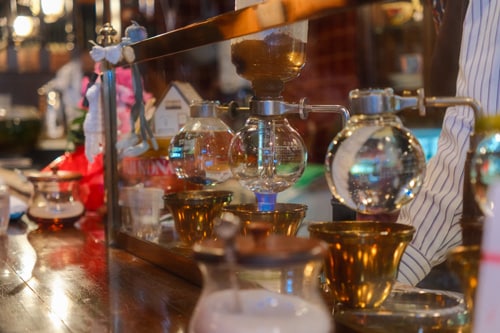
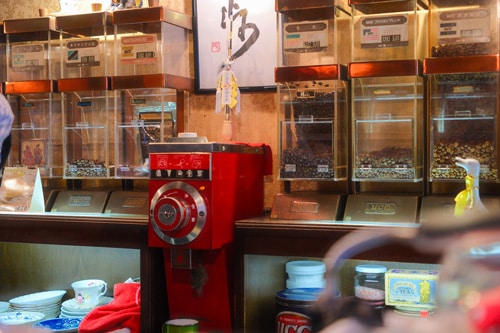
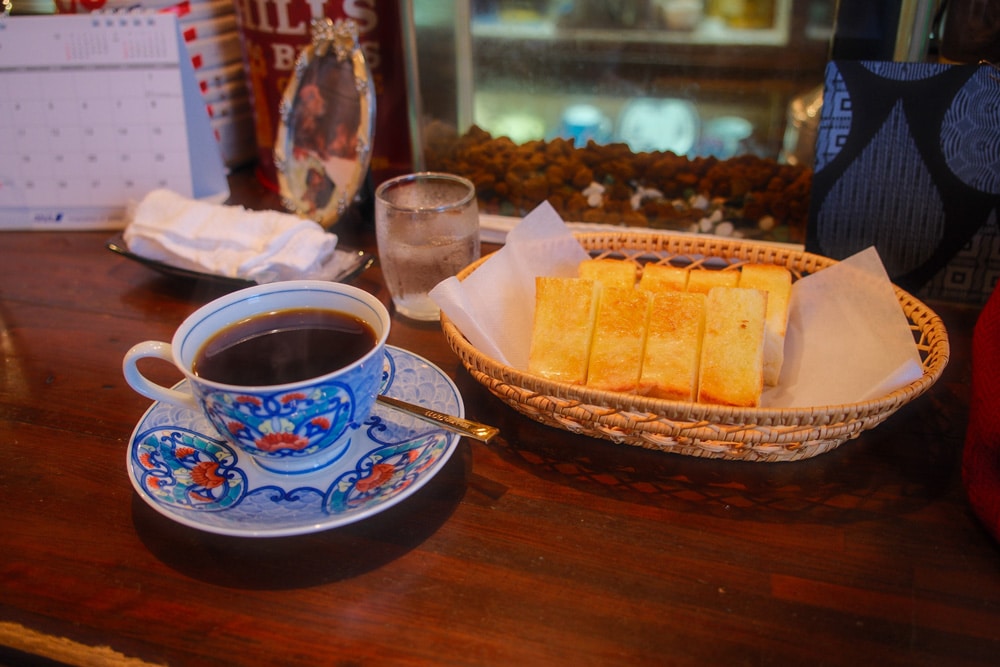
We also found the loveliest kissaten (a traditional, retro Japanese coffee shop) in the middle of Imari called 珈琲舎香月, run by the loveliest older couple. The nostalgic, dark atmosphere, filled with Showa-era memorabilia and tons of Imari ware, made for a memorable visit. The coffee, which was freshly brewed in a siphon coffee maker, and the French toast were amazing. If I’m ever in the area again, I would make a detour to Imari just for this cafe.
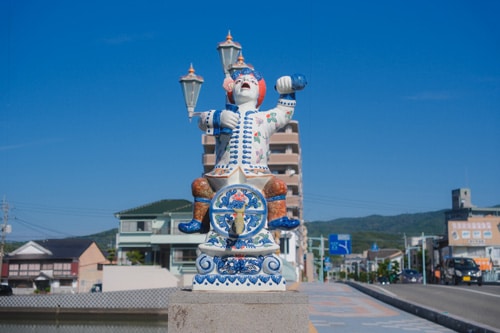
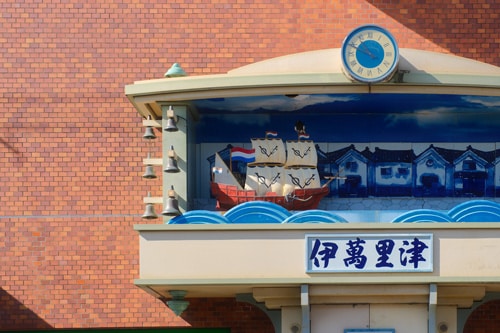
The main street in Imari, which runs straight from the train station, has some beautiful porcelain statues. There is also a large display with Dutch VOC ships near the bridge. Having grown up in the Netherlands, it was very interesting to see the connection between my home country and this seemingly small town in the middle of Saga Prefecture. But other than that, there isn’t much to see or do in Imari, which is why I wouldn’t recommend visiting unless you’re looking for a cheap base for a few days.