One of the top three hot spring towns in Japan, Kusatsu Onsen is a great overnight trip from Tokyo. If you’re planning on visiting, follow this Kusatsu Onsen itinerary to make the most of your time there.
I love hot springs, and over the years, I’ve managed to visit quite a few onsen towns in Japan. Kusatsu Onsen in Gunma Prefecture is a popular overnight trip from Tokyo and is rated as one of the top three hot spring towns in the whole of Japan.
Whether you’re planning to go for a trip from Tokyo or stop on the way while travelling to other areas in Central Japan, Kusatsu Onsen won’t disappoint. The cosy atmosphere of the small town and the hot spring steam that fills the streets is incredible!
Kusatsu Onsen is also a popular ski resort, but as we visited during spring, I’ll mainly focus on the other aspects of Kusatsu that you can enjoy year-round. So, if you’re visiting Kusatsu Onsen soon, here are my recommendations.
Kusatsu Onsen Itinerary Overview & Map
Kusatsu Onsen is located in the Gunma mountains, at around 1,200 meters of elevation. Alongside Gero Onsen and Arima Onsen, it’s one of the three famous hot springs (Nihon Sanmeisen). Even nowadays, it consistently ranks among the top onsen in Japan.
From Tokyo, you can get to Kusatsu Onsen by express train and bus within three hours, making it a popular overnight destination – especially for onsen lovers.
Legend says the hot springs in Kusatsu were found over 1,800 years ago, making it one of the oldest onsen towns in Japan. The minerals and anti-bacterial properties of the hot water that bubbles up from the found here are supposed to heal all sorts of illnesses, improve your skin health and relieve joint and muscle pains.

The water in Kusatsu Onsen is very acidic, with a pH between 1.6 – 2.1. According to the official website of the town, a 6-inch nail will dissolve if left in the water for 10 days. Because of its acidity, the water has strong sterilising qualities, which essentially disinfects your body when bathing.
Every minute, over 32,000 litres of hot spring water gushes out of the ground in Kusatsu Onsen, making it the most active onsen source in the country according to the Japan Onsen Association.
As Kusatsu Onsen isn’t a very large town, it’s easy to get around on foot. It has a cosy atmosphere where we felt at home as soon as we got used to the strong sulfuric smells. If you’re planning to visit Kusatsu Onsen for an overnight stay, you can use this itinerary and map to make the most of it:

Kusatsu Onsen Itinerary
Kusatsu Onsen is best experienced when staying for at least one night. The iconic wooden frames that carry the fresh hot spring water are lit up at night. The steam rises up and creates a wonderful atmosphere. On top of that, there’s nothing better than walking around an onsen town in the evening while wearing a yukata – it adds so much to your trip!
If you’re visiting Kusatsu Onsen for two days, I recommend doing the following:
- Arrive in Kusatsu Onsen around midday and have lunch somewhere
- Stroll around the town, see the Yubatake and walk through Sai-no-kawara Park
- Check in to your Ryokan and enjoy the onsen
- Dress up in yukata at night and walk around the Yubatake, try some of the free footbaths
- The next day, go see a traditional yumomi performance in the morning
- Visit the shrines in Kusatsu Onsen and/or visit another public bath
- Have one last stroll around town, try the kao-yu (face bath) and do some shopping.
Here is more information about each spot on the itinerary in Kusatsu Onsen:
1. See the Yubatake
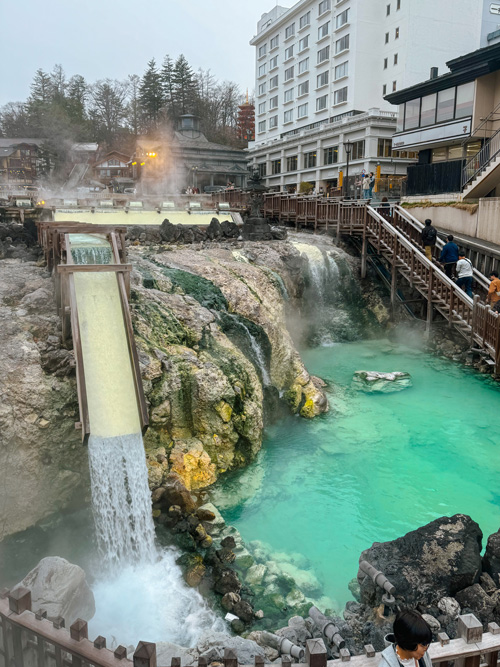
In the centre of Kusatsu Onsen, you’ll find the most iconic landmark of the town: the Yubatake (湯畑). It literally translates to “hot water field” in English, and that’s essentially what it is. Seven lines of wooden frames slowly carry the fresh hot spring water to help cool it down before it’s distributed to local ryokans and bathhouses.
The Yubatake is one of the most active hot spring sources in Japan, with around 4,000 litres bubbling up from the Earth every single minute. When the water comes up, it’s way too hot to bathe in (between 50–95 degrees Celcius), so exposing the water to the fresh mountain air helps it cool down. The steam rising from the frames is a beautiful sight!


At the end of the frames, the water cascades down into a small pool. The yellow-green sulfuric sediment you can see building up in the frames is called yunohana (湯の花). This means “hot water flowers” and after it’s crystalised, it’s collected and sold as bath salts around the town. It can be a great souvenir to bring home.
The strong sulfur smell around the Yubatake can be a bit offputting, but you do get used to it after a while (I promise!). As it’s located in the middle of the town, you can find many restaurants and cafes around this area too.
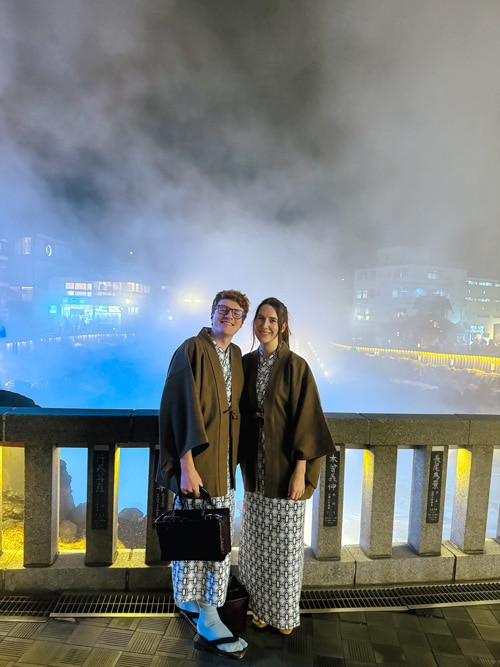
The Yubatake is illuminated with colourful lights at night, making it even more beautiful. The steam seems way more prominent with the lights shining on them. Lots of people will walk around in their yukata and geta slippers. Since most ryokans have these available for free, I would recommend trying them on yourself for a little evening stroll around the Yubatake. It was magical!

2. Watch a Yumomi Performance at the Netsu-no-yu
While the Yubatake is the main way Kusatsu’s hot spring water is cooled down before you can bathe in it, there used to be another way: Yumomi (湯もみ). Yumomi is the traditional way used to cool down the nearly boiling water, dating back to the Edo Period (1603 – 1868).
Nowadays, you can still see the traditional yumomi performance in the Netsu-no-yu bathhouse, which is located next to the Yubatake.
With wooden planks of around 180 centimetres, a group of locals stir the water to cool it down without diluting the natural minerals. The performance is accompanied by traditional folk songs. Since yumomi is such a unique part of Kusatsu’s history, it’s worth getting a ticket to one of the shows.

There are six shows every day, at 9:30AM, 10:00AM, 10:30AM, 3:30PM, 4:00PM, and 4:30PM. Tickets are available half an hour before each show. You’re not able to book them for later in the day, so you’ll have to show up on time. Once they’re sold out, that’s it. Make sure you get there in time if you want to watch it. Tickets cost ¥700 for adults, ¥350 for children.
Once we sat down, a video was played explaining Kusatsu’s history and showing some information about the onsen water (with English subtitles). The show itself started with a dancing and singing performance by three women dressed in yukata. Afterwards, the large wooden panels came out and were used to stir and flip the water into the air. The show lasted around 30 minutes. It was a very unique and memorable experience!
The Kusatsu-bushi song they play at the start and end of the performance has lived rent-free in my head since visiting. My husband and I still sing it at home all the time.


3. Try the Free Footbaths (Ashi-yu)
Free footbaths are often found in onsen towns, including Kusatsu Onsen. You can find a few around Yubatake (called Yu-kemuri Tei), one in front of Jizo-no-Yu bathhouse and a large one in Sainokawara Park.
The footbaths are free to use and open 24/7. They’re perfect to rest your tired feet after walking around and exploring Kusatsu Onsen. I tried Yu-kemuri Tei in the evening while walking around the Yubatake in my yukata, and it was a great experience.

Remember to bring a small towel to dry your feet afterwards!
4. Soak in One of Kusatsu’s Public Onsen
A visit to Kustasu Onsen obviously isn’t complete without trying the healing waters yourself. There are lots of different baths available in the town, so you’ll be spoiled for choice. Here are the ones that are open for day guests:
- Sai-no-Kawara Rotenburo – Located in Sai-no-Kawara Park, this is one of Japan’s largest outdoor baths. You can enjoy the beautiful nature around, and even stargaze at night. This public onsen also allows for mixed bathing (men and women together) with a bathing suit every Friday evening. It’s a great way to enjoy it with your whole family. Entrance costs ¥700 for adults, ¥350 for children.
- Otaki-no-yu – This popular bathhouse has multiple baths with different water temperatures, including a large outdoor bath with a waterfall. Entrance costs ¥980 for adults, ¥450 for children.
- Goza-no-yu – This bathhouse takes water from two different hot spring sources in Kusatsu, the Yubatake and Bandai. Entrance costs ¥700 for adults, ¥450 for children.
According to Kusatsu’s official website, there are 19 public bathhouses that Kusatsu residents can use for free. Only three of them, Shirahata-no-yu, Chiyo-no-yu, and Jizo-no-yu also accept visitors to enter. They remain free even if you’re not a Kusatsu local. The water in these bathhouses is often very hot though!
Bear in mind that Chiyo-no-yu and Jizo-no-yu stick with the traditional jikan-yu way of bathing. Jikan-yu is a bathing technique where you bathe in high-temperature hot spring water for a short time (usually around three minutes). You have to follow the instructions properly when going to these public baths.
Remember to bring your own towel from the ryokan you’re staying in, as you’ll have to hire or buy one otherwise.
It’s also worth checking if your ryokan has an onsen. During my time in Kusatsu Onsen, I stayed in Kirishimaya Ryokan which had both a public and private bath available for guests.
Do not wear jewellery when bathing in Kusatsu’s hot spring waters, as the strong acidity can cause discolouration.
5. Walk Through Sai-no-Kawara Park
A short 10-minute walk from the Yubatake, you’ll find Kusatsu’s Sai-no-Kawara Park. En route, you’ll walk through Sai-no-Kawara Street, which is lined with shops, cafes and restaurants.
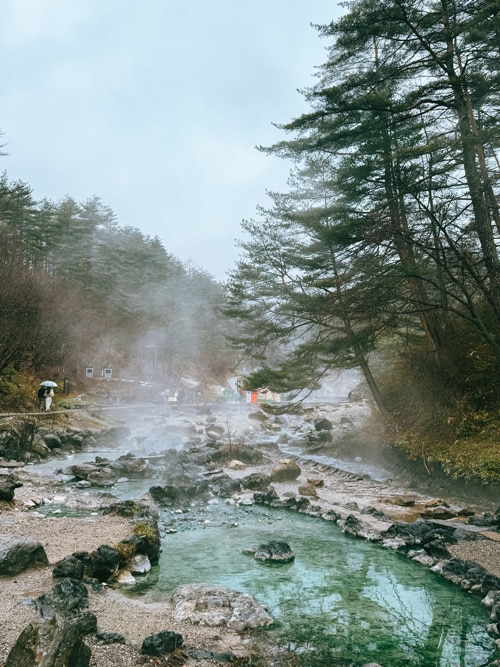
The park itself is basically a valley filled with hot spring streams and pools. You can follow the path walking through them. As this is the Sai-no-kawara hot spring source, you can even see the fresh water bubble up from out of the ground.
There are a few pools with seating built around them, so you can use them as a free foot bath. At the end of the park, you can also find one of Kusatsu’s public bathhouses “Sai-no-Kawara Rotenburo”. Just like the Yubatake, the park lights up at night. The rising steam makes for a magical sight.

6. Try the Free “Kao-Yu” (Face Bath)
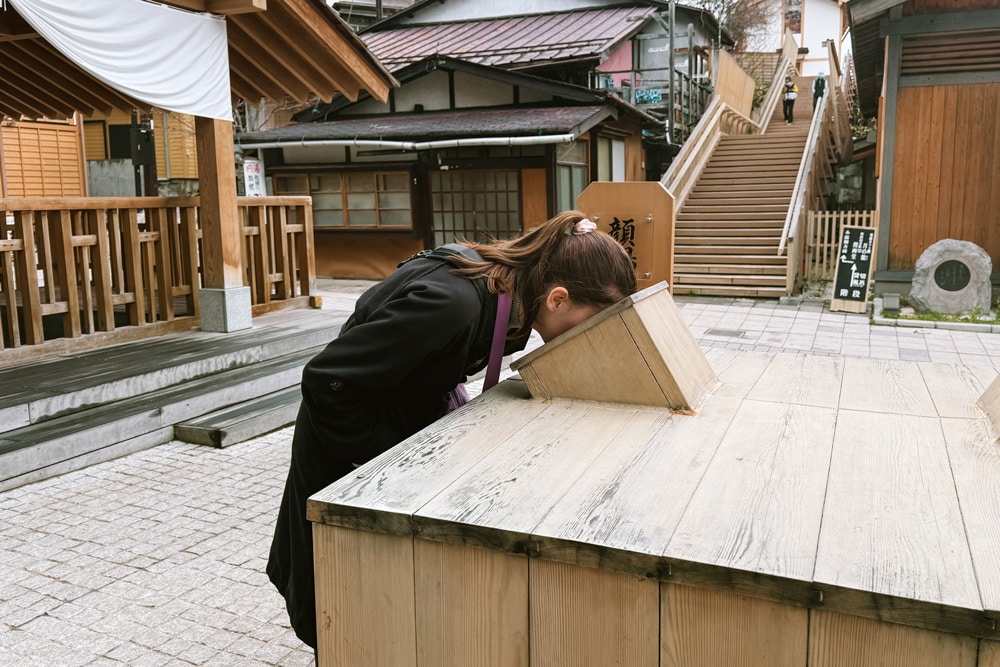
Free footbaths are often quite common in onsen towns, but Kusatsu has a pretty unique bath you can try for free too: a face bath. It’s the first time I’ve come across one in Japan, and after some research online, I’ve not been able to find any others!
You can find this Kao-Yu (face bath) outside of Jizo-no-Yu bathhouse. To try this face bath, you don’t have to stick your face underwater, but instead, you steam your face with the hot spring water.
It looks like a big wooden box with a small opening on the top. Here, you can rest your face and enjoy the steam. Despite the strong sulfur smells, it was pretty nice to try – definitely a first for me!
7. Stop by one of Kusatsu Onsen’s Temple
One of the main temples in Kusatsu Onsen sits on the small hill next to Yubataka. Kōsenji Temple (光泉寺) is part of the three hot spring healing Buddha temples, together with Onsen-ji in Arima Onsen and Io-ji in Yamanaka Onsen.
A special event, called Yume no Akari, is held on the steps that lead up to the temple. Around 1,200 candles are lit creating a beautiful sight – this happens between March and November on the second and fourth Saturday (or holiday).
8. Eat All the Delicious Kusatsu Onsen Treats
Japan is known for its amazing cuisine, and Kusatsu Onsen has more than enough special treats to try. Here are some of my favourites:
Onsen Tamago
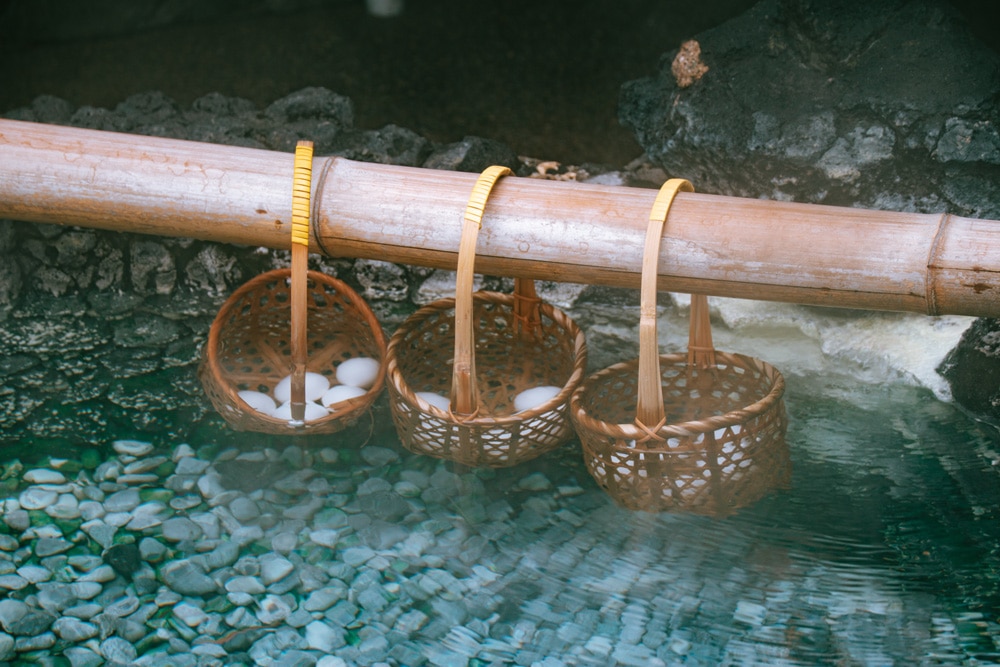
You can try Onsen Tamago near Kusatsu Glass Warehouse on Sai-no-kawara Street. Onsen Tamago is a staple in many hot spring towns, where eggs are slowly boiled in the natural spring water.
Onsen Manju
Another snack you can find in many onsen towns is Onsen Manju. These are buns with a filling, often red bean paste, steamed over the hot spring water. There are multiple shops on Sai-no-kawara Street that sell them. Some shops even give out some free samples, but don’t feel like you have to buy anything.
Kusatsu Onsen Tiramisu
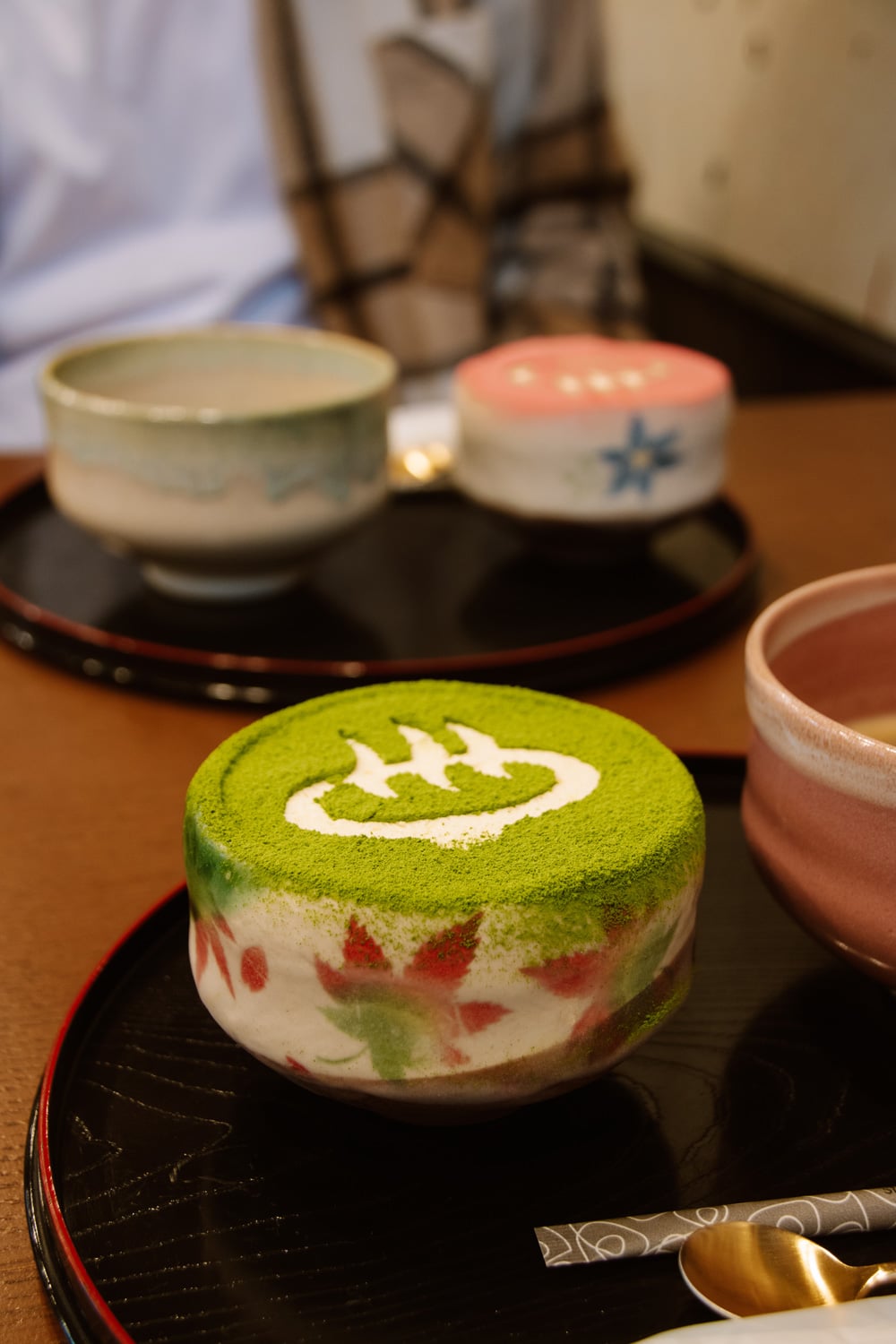
When wandering down the streets of Kusatsu, we stumbled upon a small confectionery shop, called Seigetsudo. Since 1923, they’ve been specialising in hanaingen (a type of sweet beans).
Attached to the shop, you can also find a small cafe where they sell special tiramisu. I tried the one with matcha and hanaingen, while my husband opted for the seasonal sakura flavour. The set came with a cup of coffee – delicious!
How Many Days Should In Kusatsu Onsen?
You’ll want to stay for at least one night in Kusatsu Onsen, especially if you’re travelling all the way from Tokyo. Even if you’re stopping at Kusatsu Onsen on the way to another destination, staying overnight is a must to enjoy this town properly. Bonus points if you stay in a cosy ryokan with onsen.
While you can see most of the sights in Kusatsu Onsen in one day, hot spring towns aren’t really a sightseeing destination. They are there to relax and unwind, and a place to experience ryokan culture. Plus, the Yubatake looks beautiful at night when it’s lit up. Dress in your yukata and geta and walk around the steaming pools of hot spring water – it was one of my favourite moments in Kusatsu.
Where to Stay in Kusatsu Onsen
There are a decent number of hotels and ryokans you can choose from in Kusatsu. I would definitely opt for a traditional ryokan to add to your visit. Bonus points if they have a (public and/or private) onsen.
During our visit to Kusatsu, we stayed in Kirishimaya Ryokan. This charming family-run ryokan tucked away in the hills close to Kusatsu’s main attractions was simply incredible.

The ryokan is a bit old, but it’s well-maintained and has so much charm. In the main areas, small knickknacks are scattered around and the welcoming family who runs the place helped us feel at home immediately. You can immediately see and feel the care that this family puts into their business. The large welcome board outside even had all the family names of the guests handwritten on it, such a lovely extra touch.
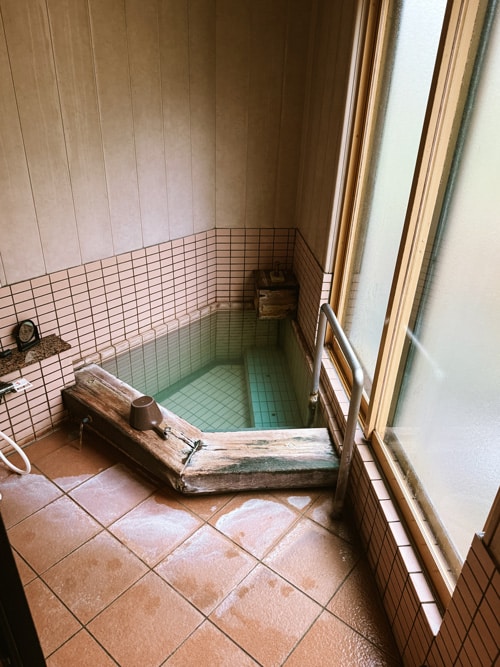
The Ryokan has a public onsen and a tiny private onsen that you can use whenever it’s free. The private onsen is a bit small but perfect for two people. From the main building, it’s a little walk outside next to a small shrine to get to the private bath. Keep in mind that while your room will have a toilet, you’ll need to use the showers at the onsen baths.
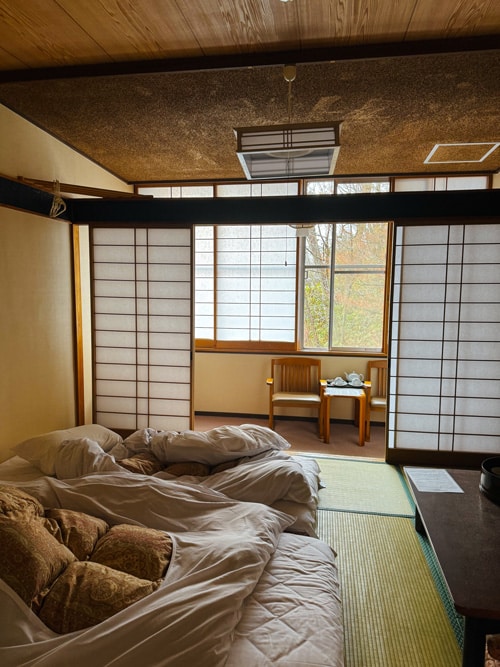
The room was great too, and included a beautiful tatami room and fluffy futon. At the end of our stay, the owner even drove us to the bus station with our luggage – I would easily book this place again when we are returning to Kusatsu.
Is Kusatsu Onsen Tattoo Friendly?
Not all baths in Kusatsu Onsen are tattoo-friendly, but some public baths accept guests with tattoos without any issues or having to cover up. These include Sai-no-kawara, Otaki-no-yu and Goza-no-yu. If you have tattoos, you can also opt for accommodation with a private onsen.
Since tattoos are traditionally associated with the Japanese mafia (yakuza), some more traditional places still won’t accept guests with visible tattoos. These are spots like onsen, gyms, pools and beaches.
However, more and more places are open to people with tattoos, including some popular hot spring towns. Kinosaki Onsen, for example, is a town with seven public baths that are all tattoo-friendly.
How to get to Kusatsu Onsen From Tokyo
Kusatsu Onsen is located around 200km from Tokyo, in the mountains of Gunma Prefecture. You can reach it by public transport in under 3 hours from Tokyo. It makes for a great weekend trip or a stopover when travelling to other areas in Japan, like Nagano or Gifu.
Because of its relatively good connections, Kusatsu Onsen is often classed as one of the best onsen trips from Tokyo – on top of the fact that it consistently ranks as one of the best hot spring towns in the country.
From Ueno Station, you can take the Limited Express train to Naganohara-Kusatsuguchi Station (2.5 hours). You can also take local trains to get to Naganohara-Kusatsuguchi Station, but these will take around 4 hours.
You can also use the train from Tokyo Station to Takasaki Station, and transfer to a train that will take you to Naganohara-Kusatsuguchi Station. This route will take a bit longer.
At this station, you can find a bus that goes straight to Kusatsu Onsen (30 minutes). Kusatsu Onsen doesn’t have a train station, so taking the bus for the last bit is the only way to get there on public transport – but keep in mind that this is a large tour bus, with storage for large bags, so it’s a comfortable ride.
Alternatively, you can use the highway bus to get straight from Tokyo to Kusatsu in around 4.5 hours. Busses leave from both Tokyo Station and Shinjuku Station multiple times a day. You can pre-book seats for this bus here.
Conclusion – Is Kusatsu Onsen Worth Visiting?
Kusatsu Onsen is definitely worth a visit. Having visited quite a few hot spring towns over the years, I was very impressed by Kusatsu’s atmosphere and onsen. Hidden in the Gunma mountains, Kusatsu Onsen feels like a charming little town – and is especially beautiful in the evening when the Yubatake is lit up.
As Kusatsu Onsen is continuously ranked as one of the best onsen towns in Japan, it’s the perfect place for an overnight stay. I personally prefer it to Hakone if we’re looking just at the hot springs. Even though Kusatsu Onsen is a bit further from Tokyo, I think it’s worth the trip if you stay overnight.







Thank you for this! I’m planning to visit Kusatsu onsen next month and this is exactly the sort of breakdown I was looking for.
Great article, many thanks!
Can you make any suggestions for onward travel please (instead of back to Tokyo)‽
Thanks in advance
Brigitte
Thanks! We went on to Nagano from here and then onwards to Takayama, the Japanese Alps and Kanazawa 🙂