Nikko is a world away from the bright neon lights of Japan’s big cities. This is a place where vermilion bridges curve over misty rivers, Buddhist statues line the forest paths and pagodas rise silently amongst the trees.
It’s also highly unlikely that you’ll have Nikko’s ancient temples to yourself. Convenient tourist passes have made it a fixture on the tourist trail, and it’s also a popular day trip destination for Tokyo residents.
Nevertheless, I’ve always enjoyed my trips to Nikko and I would recommend it to anyone with a fascination for ancient temples and the shōgun of old. Here’s the Nikko itinerary I usually follow to make the most of a one-day stop in the mountains.
- Nikko Day Trip Map
- How to Spend a Day in Nikko
- 1. Take the Train from Tokyo to Nikko
- 2. Snap a Photo of the Shinkyo Bridge
- 3. Coffee at Hongu Cafe
- 4. Visit Rinnōji Temple and Pay Your Respects to the Mountain Gods
- 5. Head up the Avenue to the Tomb of the Shogun
- 6. View the Intricate Carvings of Nikko Tōshōgū
- 7. Visit Futarasan Shrine to Experience Nikko's Spiritual Heart
- 8. See the Spectacular Tokugawa Architecture of Taiyu-in
- 9. Take a Break at Nikko Coffee
- 10. Walk Through the Kanmangafuchi Abyss
- 11. Take the Train Back to Tokyo
- Nikko Day Trip FAQs
- Final Thoughts on Visiting Nikko
Key Takeaways
– Get a Nikko Pass World Heritage Area to save money on trains and make transport around Nikko easier
– Save time to check out some of the side temples like Taiyu-in if you want a more relaxed mountain experience
– Go during the autumn foliage season for beautiful photographs, but be prepared for increased crowds
– An overnight trip will help you explore more of Nikko National Park, including the Kegon Falls and Lake Chūzenji
Nikko Day Trip Map
Here’s a quick overview and map for this Nikko day trip:
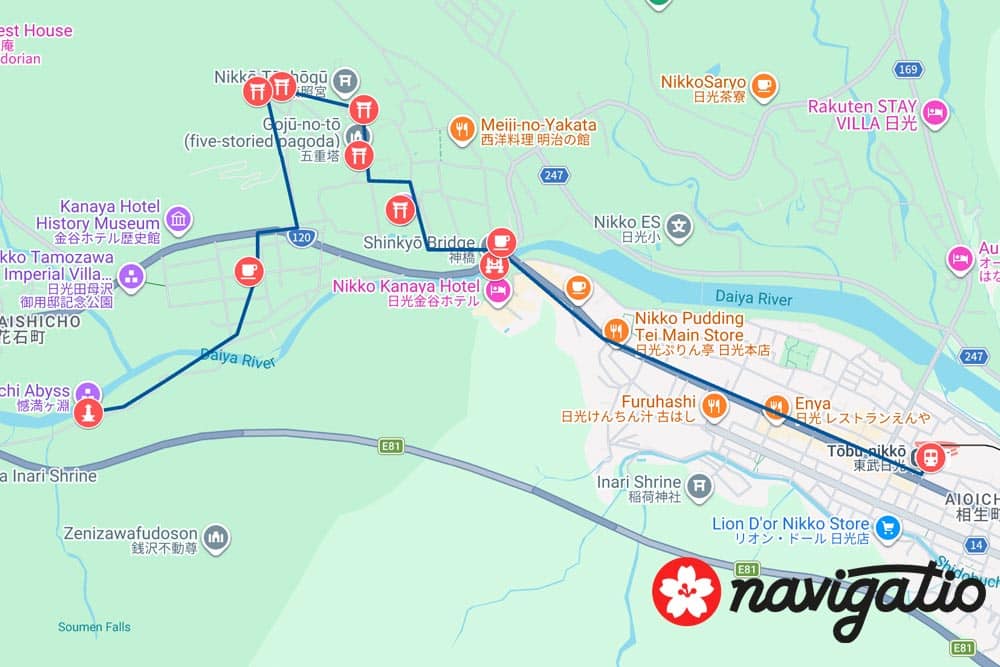
How to Spend a Day in Nikko
Here’s how to spend a full day exploring the temples of Nikko:
1. Take the Train from Tokyo to Nikko
To make the most of your day trip to Nikko, it’s best to leave as early as possible. The train from Tokyo to Nikko takes around 2–3 hours, and you wouldn’t want to miss out on exploring time.
There are a few different ways to reach Nikko. The best option for you depends on which train pass you have:
| With the Nikko Pass | With the JR Pass | |
| Route | Tobu Nikko Line | JR Tohoku Shinkansen and JR Nikko Line |
| Departure Station | Tobu Asakusa Station | Tokyo Station or Ueno Station |
| Transfer | – | Change to JR Nikko Line at Utsunomiya Station |
| Arrival Station | Tobu-Nikko Station | Nikko Station |
| Time | 2 hours with limited express tickets; 3 hours on local trains | 2 hours with Shinkansen tickets |
| Cost | Free with the Nikko Pass; up to ¥3,480 extra for limited express tickets | Free with the JR Pass |
You can also take the bus to Nikko from Tokyo, but since it takes over 3 hours, it’s not a good option if you’re taking a day trip. Alternatively, you can book a planned day trip to Nikko.
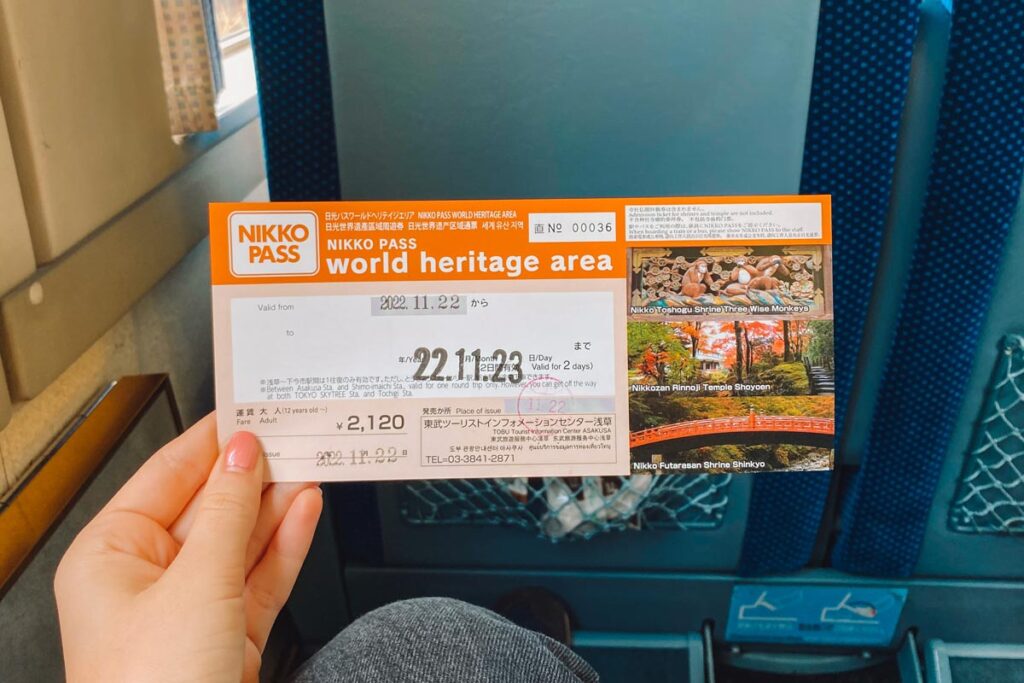
On my trip, I used the Nikko Pass to save some money, as it works out cheaper than a return ticket, even with the limited express tickets. Once you arrive at Tobu-Nikko Station, you can also use the pass for unlimited bus journeys in the World Heritage area. This includes the bus from the station to the Shinkyo Bridge, your next destination.
2. Snap a Photo of the Shinkyo Bridge
One of Nikko’s most famous sights is the Shinkyo Bridge, which is the first stop on our itinerary. From Nikko train station, it only takes around 5 minutes by bus to get here. Alternatively, it’s roughly 20–30 minutes on foot.
The Shinkyo Bridge dates back to 1636 and marks the start of the World Heritage Site. Legend says that when the first head priest of Nikko asked the mountains for a way to cross the river, two snakes appeared and turned into the bridge.
It’s one of the most beautiful bridges in Japan, especially if you can catch it with the autumn foliage in the background. However, since it’s right next to a busy intersection and the main entrance to the Nikko temple complex, it’s not the most serene spot. There will be plenty of people walking past, so you’ll need a bit of patience if you want that perfect photo.
After renovations in the 1990s and 2000s, the bridge was opened to the public and you can now walk across for a few hundred yen. However, since the joy of the bridge is mostly from looking at it, I would recommend saving your cash.
Travel Tip
Autumn is a beautiful time to visit Nikko if you want to capture the vivid colours of the autumn foliage. The mountainous areas north of Tokyo see the autumn leaves peak a couple of weeks earlier than in the city, so you should aim for early or mid-November if you have your heart set on that autumn shot of the Shinkyo Bridge. Just be prepared to fight the crowds for it!

3. Coffee at Hongu Cafe
Hongu Cafe is a small cafe near Shinkyo Bridge, and I’m so glad we accidentally stumbled upon it. Desperate for some coffee, we entered this traditional cafe.
The interior was so lovely, and the staff was very welcoming. I took off my shoes upon entering, slipped into the provided slippers, and sat down at one of the tables to enjoy my morning coffee. It was very quiet when I visited, only two other travellers sat down for a drink, but it was wonderful.
From there, I watched the beautiful garden while drinking my coffee. It’s one of the nicest cafes we visited in this area. Definitely a spot to check out if you have the time!
Travel Tip
If you’re feeling hungry, there are also plenty of restaurants and cafes along the road from the station to the World Heritage site entrance. Despite its mountain location, there’s actually a fairly decent variety of things to eat on the main road, including ramen, steak and teishoku sets.

4. Visit Rinnōji Temple and Pay Your Respects to the Mountain Gods
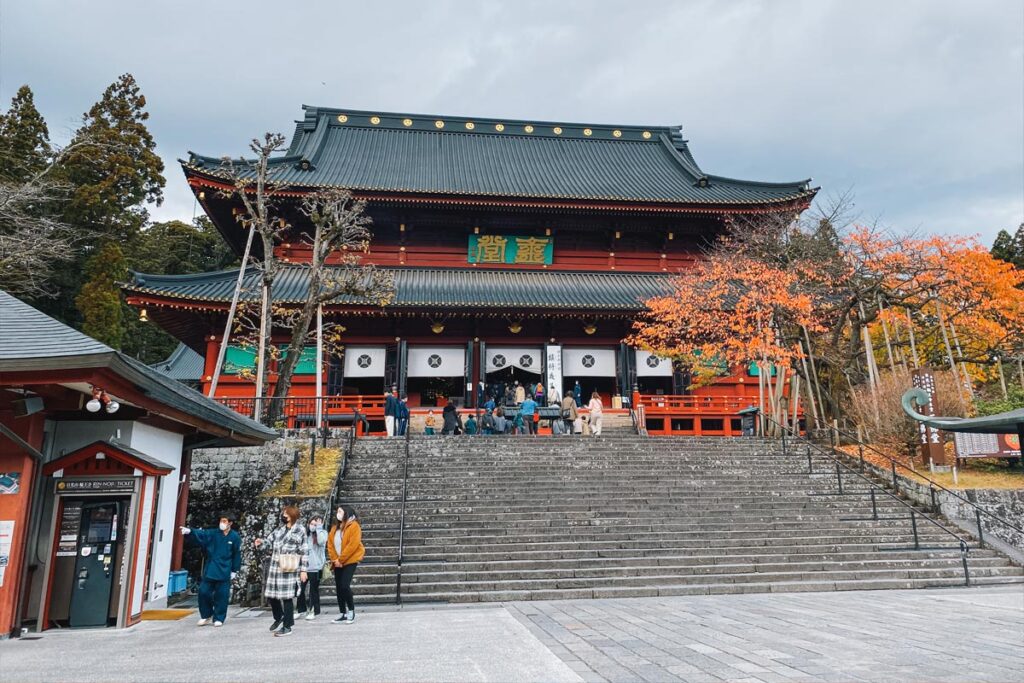
Up the stone steps from the cafe, Rinnōji is the first big temple you’ll come across as you enter the world heritage site. Founded in 766 by the Buddhist monk Shodo, it underwent a long restoration, which was completed in 2019. Now it stands at the bottom of the approach to Toshogu in its renewed vermilion splendour.
Nikko has more than its fair share of temples, and if you’re tight on time, it’s best to head straight up to Toshogu. Having said that, I particularly enjoyed my visit to Rinnoji Temple.
This was because of the eight-meter gold statues that you can find inside. These represent the deities of Nikko’s mountains, and it felt right to pay a brief visit before entering their domain. You can also find a Japanese garden behind the shrine, which you can visit for a small fee.
5. Head up the Avenue to the Tomb of the Shogun
The main courtyard of Rinnōji also connects to the main avenue leading up to Tōshōgū, the final resting place of one of the most important figures in Japanese history: the first Tokugawa shogun, Ieyasu.
It’s a short walk between the two temples, but one worth savouring. Tōshōgū is particularly photogenic during the autumn, when the foliage adds splashes of colour to the world heritage site.
I was too early for the leaves on my last visit, but it was still very atmospheric. The rows of cedar trees, moss-covered walls and temple buildings peeking through the trees all add to the otherworldly feeling.
At the top of the avenue, I came through a torii gate and finally caught sight of the five-story pagoda that marks the entrance to the temple grounds. You won’t have it to yourself as there’s also a big queue in the courtyard for the ticket office, but it’s still a majestic welcome to the world of the shogun: a completely different side of Japan to the big cities like Tokyo and Osaka.

Stay connected to the internet during your trip to Japan (essential for using apps like Google Maps & Translate!) with an eSIM. Journey Japan eSIM specialises in eSIMs in Japan, making them the best option for your next trip. (Read our full review here)
6. View the Intricate Carvings of Nikko Tōshōgū
Nikko Tōshōgū is the most famous landmark in the area and the one that I spent the most time at during my day trip to Nikko. Dedicated to Ieyasu Tokugawa, Nikko Tōshōgū is the supposed resting place of the shogun who unified Japan, although there is still some scholarly debate since the tomb has not been opened in 400 years.
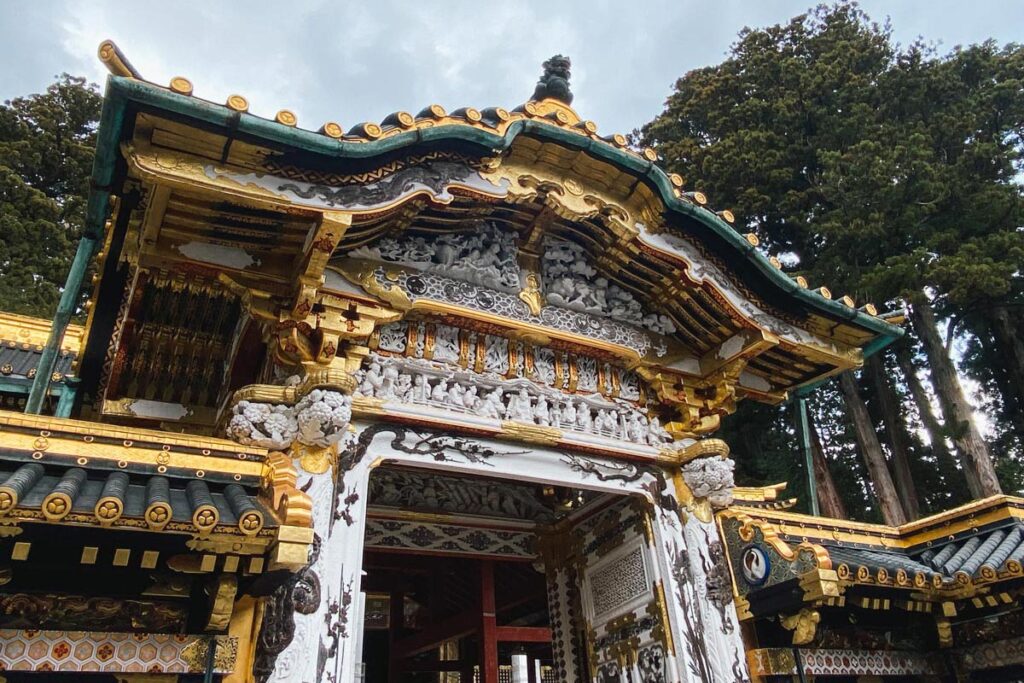
Tōshōgū is one of the most lavishly decorated shrines in the whole of Japan. It took my breath away. The details that are carved into the wood are out of this world. Simply for this shrine, I believe it’s worth taking the trip to Nikko.
The 508 different carvings on the Yomeimon Gate are so spectacular that the architects had to add one of the pillars upside down to avoid reaching a state of complete perfection. Take a minute and see which pillar is not placed correctly, as it was harder than I expected to figure out!
There are a number of other small buildings to explore in and around the complex, including bell towers, storehouses and other smaller shrines. Since they’re all so beautifully decorated, it’s very easy to spend a couple of hours wandering through the different buildings and reading the signs.

The Animal Carvings at Tōshōgū
There are a few particularly famous carvings to keep an eye out for as you take in the spectacular architecture at Tōshōgū.
Probably the most famous carving is of the Three Wise Monkeys on the Sacred Horse stable, just around the corner from the Omotemon entrance gate. The monkeys cover their eyes, mouth and ears as advice to see no evil, speak no evil and hear no evil, respectively. You might also recognise them from your phone’s emoji keyboard.
The Sleeping Cat Carving, known in Japanese as nemurineko, is also particularly famous. It can be found on the Sakashitamon Gate, the entrance to the grave of Tokugawa Ieyasu. It’s quite small, but there’s often a big queue of people waiting to take a photo, so you shouldn’t miss it. On the other side, you can find a carving of two sparrows, which represents the co-existence of the strong and the weak.
The Shogun’s Grave
After walking through the Sakashitamon gate, you’ll find a long flight of stone steps leading you up to the inner shrine. Tokugawa Ieyasu is purportedly buried beneath the pagoda at the top, although the grave hasn’t been opened since Tokugawa was laid to rest in 1617.
Contrasting with the extravagance of the main shrine, the tomb is a comparatively simple copper urn in the cedar forest. The simplicity gives it something of a magnetic quality, and I completely understood why many Japanese people consider this to be a “power spot.”
SponsoredCheap Flights to Europe & USA
Book your tickets now and save up to 40% on top destinations.
You can also find a wish-granting tree near the grave. It already stood here before the shrine was built, and legend says your wish will be granted if you pray while facing the hollow tree.

7. Visit Futarasan Shrine to Experience Nikko’s Spiritual Heart
From the entrance to Tōshōgū, the next shrine is just a short walk away. Similar to the approach to Tōshōgū, the path from Tōshōgū to Futarasan is lined with large cedar trees. The smaller crowds in this part of the complex allow you to experience a mountain atmosphere that feels almost ethereal.
Futarasan is dedicated to the god of Mount Nantai, one of Nikko’s mountains. It’s actually older than Tōshōgū Shrine, and while it’s nowhere near as elaborately decorated, it’s one of Nikko’s main places of worship. The shrine was founded by the Buddhist monk Shodo, the same person who founded Rinnoji Temple and Shinkyo Bridge.
The shrine is free to visit, with the exception of a garden with some beautiful sacred trees, but this isn’t essential to your day in Nikko.
8. See the Spectacular Tokugawa Architecture of Taiyu-in
If you’re in the mood to see more extravagant Tokugawa architecture, leave some time in your itinerary to check out Taiyu-in. Located just across from Futarasan Shrine, this is the tomb of Tokugawa Iemitsu, the third shogun and grandson of Ieyasu.
Tokugawa Iemitsu was responsible for many of Toshogu’s most spectacular design choices. While his tomb is deliberately not quite as opulent as his grandfather’s, it’s still filled with gorgeous architecture worthy of a shogun.
The approach to the shrine is particularly beautiful, taking you over a stone bridge, up ancient stairways and through spectacular vermilion gates. I even saw a snake sunning itself on the bridge during one summer visit! I’m not sure if it was a sign from the gods, but it shows that nature is waiting to fill any gaps left by the crowds of day-trippers.
Iemitsu’s mausoleum is around the corner from a stunning shrine that features liberal use of gold lacquer and gorgeous paintwork. The tomb is also pretty striking with its white paint and gilded door, which is closed to visitors. Who knows what mysteries lie within!
9. Take a Break at Nikko Coffee
Excuse me while I recommend yet another place to grab a coffee… But this local cafe is en route to the Kanmangafuchi Abyss, and it sells great coffee! There are also some other food vendors nearby if you want to grab a late lunch or a quick snack.
From Futarasan Shrine and Taiyu-in, I walked down the long road towards Nikko Coffee. There are some local restaurants here too; we sadly got here too late for lunch, but they looked like great places to sit down.
Near Nikko Coffee, you can also find some souvenir shops in case you’d like to bring some Nikko goods home with you.
Travel Tip
Meguri Coffee near the World Heritage site is a great alternative if you’re looking for coffee or snacks. It’s located in a beautiful old building with tatami seating and ceiling paintings, making it perfect for a pit stop on the way to or from the shrines.
10. Walk Through the Kanmangafuchi Abyss
If you have time after exploring the World Heritage Area, there is one last item on this itinerary: the Kanmangafuchi abyss.
This narrow valley was formed after Mount Nantai erupted thousands of years ago. It now makes for a nice walking trail near the river and is one of Nikko’s most popular spots to visit.
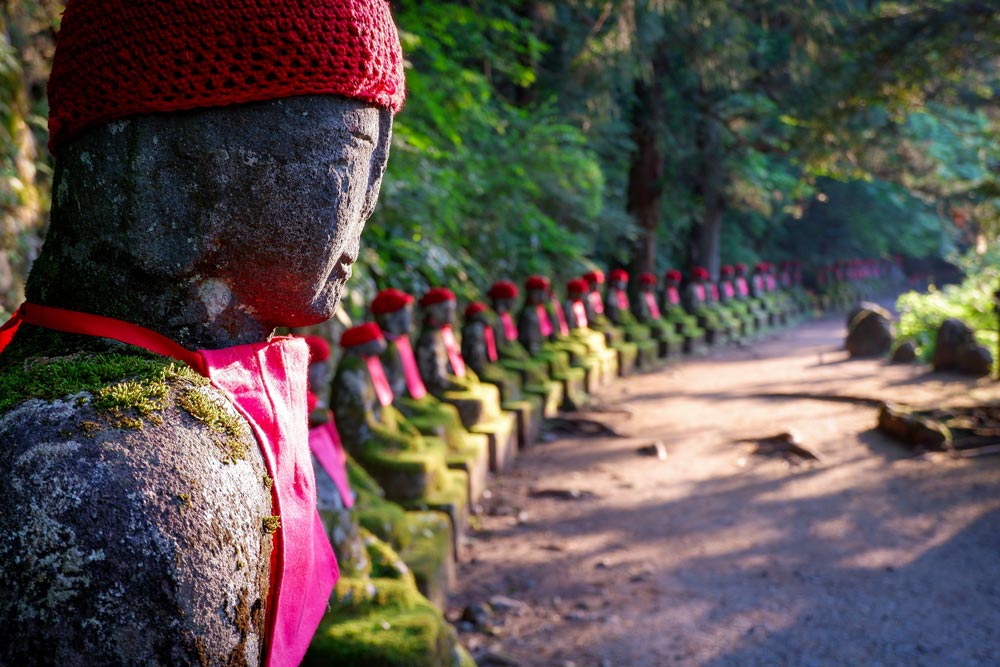
You may recognise the image of the stone statues of Jizo Bosatsu, the guardian of travellers and children, wearing red crocheted hats and bibs. There are around 70 statues, but legend says that the number changes every time you count them.
11. Take the Train Back to Tokyo
And that concludes our Nikko day trip! Make your way back to your preferred station and get the train back to the city.
One day in Nikko always goes by very quickly, since there is so much more to see in the area. Nikko offers lots of beautiful hikes, hot springs and natural sights like Kegon Falls and Lake Chuzenji, but you’ll need to stay overnight if you want to explore the national park in more detail.
The sweet spot for a Nikko trip is 2–3 days, but you can definitely condense it into a day if you’re happy to just take in the major sights and explore more elsewhere. Either way, I’m hoping I can get back to Nikko for a longer stay on a future trip!
Nikko Day Trip FAQs
Is it Worth Buying a Nikko Pass for a Day Trip?
It’s definitely worth getting the Nikko Pass (World Heritage Area) if you want to save a bit of money and make your day trip easier. The pass costs ¥3,000 and includes a return ticket from Tokyo to Nikko, as well as unlimited travel on buses and trains within certain areas and extra discounts. That’s cheaper than buying an individual return ticket to Nikko from Tokyo.
I would also recommend paying the extra fee to use the limited express train. It costs up to ¥3,480, but it will save you a lot of time. I recommend picking one of the older trains like Spacia, rather than the new Spacia X. That way, you’ll be travelling in comfort while maximising your savings.
The pass costs ¥2,120, and you have the option to pay an additional fee to use the limited express train (up to ¥2,940, which I would recommend if you’re only going for one day, as it’ll save you a lot of time). It’s still cheaper to get the pass AND the limited express compared to buying the return ticket outright.
It’s not worth getting the Nikko Pass if you already have the JR Pass, since one of the main advantages of getting the Nikko Pass is the cheap return journey from Tokyo.
Don’t bother looking at the more expensive Nikko Pass (All Area) unless you’re intending to do some serious multi-day adventuring in and around the national park.
Check out my comprehensive guide to the Nikko Passes for more information.
What is the Best Time to Visit Nikko?
The most popular time to visit is the autumn foliage in November, but bear in mind that this will also be the busiest time of year for domestic tourism. Spring also offers perfect weather for exploring, while summer and winter have fewer crowds.
Some parts of the national park will be closed during winter, so this is not the best time for a multi-day trip to Nikko.
All things considered, Nikko is a year-round destination, and you’ll probably have a good time whenever you choose to visit.
How Long Does a Nikko Day Trip Take?
It’s a pretty long day out if you’re planning to go from Tokyo to Nikko and back. On my last trip, we got on the train to Nikko at around 9:30 AM, arriving at around 11:30. We had enough time to wander up to the shrine and see the main sights before taking a train back at around 5:00 PM. We got back to Tokyo at around 7:00 PM.
If you want to hit every item on this itinerary, you should plan to arrive in Nikko by mid-morning. Keep in mind that the village starts to close at around 4:00 PM or 5:00 PM, so there’s not much point in taking a later train back.
Should You Visit the Kanmangafuchi Abyss Before Tōshōgū?
You can certainly do this itinerary in reverse and have a great day out in Nikko, but I wouldn’t necessarily recommend it.
Tōshōgū and the shrines of the World Heritage site are the primary reason to make the trip out to Nikko. There are sometimes long queues at the Tōshōgū ticket office and the shrine complex closes at 4:00 PM or 5:00 PM, depending on the season, so it’s best to plan your day around the shrine visit.
If you’re more interested in getting out into nature than visiting the shrines, you could also look at some day trip options closer to Tokyo. These include Oku-Tama, Mount Mitake and the area around Fuji Five Lakes. Further afield, the Nakasendo, Kamikochi and the Japan Alps are great options for extended hiking trips.
Final Thoughts on Visiting Nikko
Nikko is a fantastic place to visit and 100% worth a day trip. Especially with the Nikko Pass, it’s easy to travel from Tokyo and explore the World Heritage Area in one day. It’s best to pay for the additional limited express fee, as this will take you to Nikko in two hours rather than three on the local train.
Because there’s so much to see in Nikko, it’s even better to spend two or three days here. Try out one of the area’s beautiful ryokans and onsen hotels and get out into the beautiful nature of Nikko National Park for a deeper experience of Japan’s wilder places.

Top Rated Hotels & Resorts
Discover luxury and budget-friendly stays for your next trip.






This was very useful! Great quick trip to Nikkō. Thanks a lot.
Thanks Marcel! Really glad to hear it’s helpful 🙂 Hope you have a great time in Nikko!
Thanks for the itinerary and all the great tips! As i will also be traveling to Nikko from Asakusa next year. I like to know, if I do not want to spend extra and get the express ticket, to travel by local train to Nikko for 3 hours. Can i know which station i need to get off and make a transfer please?
Thank you! If you want to take the local train, you can get on from Asakusa Station towards Nikko. Some routes will ask you to change at Shimo-Imaichi Station, but some are direct. It’s best to check Google Maps on your day of travel to see which routes are the best to follow 🙂
Thanks! Do you think it would be better to do the K abyss as soon as we arrive and then see the shrines and bridge before heading back to the Tobu Nikko station?
It’s totally up to you! You can definitely swap the itinerary around and follow it counter-clockwise 🙂
Thanks a lot! 🤗
Great overview, thank you! You said most of the autumn foliage was gone. Can I ask what date you visited, please?
Thank you! We were there late November, I don’t remember the exact date 🙁
Great information, Thank you!
Will be in Japan for 3 weeks end of March to mid April. Planning on going to Nikko as a day trip from Tokyo. Hopefully not too crowded as it is Cherry Blossom. Was thinking about using a tour, but you made me change my plans as it seems something we can easily do on our own.
question : on the pass you are mentioning, it says “This pass includes a return ticket from Tokyo to Nikko, unlimited travel on busses and trains within certain areas and extra discounts.” did you mean to say a return ticket from “Nikko to Tokyo” ? otherwise I am not sure what the return ticket is for.
Thanks!
Thanks so much for the kind words! The return ticket includes the journey from Tokyo to Nikko plus the journey back from Nikko to Tokyo 🙂 Hope that makes sense!
got it. thankS!
Any recommendations for one day driver hires IN Nikko vs from Tokyo? We are staying centrally but would like to hire a local driver for one day to access the further sites. Thanks!
Unfortunately, I’ve not got any experience with any drivers in Nikko so it’s hard to recommend 🙁 Sorry!
Sorry if this is a dumb question
When i purchase World Heritage Pass for day trip to Nikko I know I have to purchase limited express ticket as well. Am I able to purchase return ticket, I can’t see where I am able to choose return, or do I have to pay for each leg separately. Thanks
Not a dumb question at all! In Japan, you can’t really buy a “return” ticket as much, so you’ll have to do it for both ways individually 🙂
What time did you catch the train back at the end of the day??
Around 4:30 🙂
I’m heading to Japan in less than 2 weeks and have included an overnight stay in Nikko. I will definitely follow this itinerary! As I’m staying overnight, I believe I can do the Kegon Falls and Lake Chuzensi the second day before heading to Osaka in the afternoon.
I want to spend 2 days in Nikko. I wonder if I should base in Tokyo or Utsunomiya .Utsunomiya is less than 1 hour away from Nikko. I can’t spend overnight in Nikko, the hotels there are too expensive. I’m having doubts in staying in Tokyo for Nikko when the trip is 3 hours, and that’s just one way right? 6 hours would be wasted on just travelling.
I’d definitely try to stay as close to Nikko as possible if Nikko itself is too expensive, not sure if it’s worth travelling 6 hours for 2 days 🙁
Thanks! Followed this itinerary yesterday. A few refinements:
Get there early. We got there around 10, but the daylight hours are short in November, and there are still crowds. Things close starting at 4. Do the Tosogu shrine first after the Shinkyo bridge and before coffee because the lineups there quickly become crazy. I also highly recommend the Taiyuin Mausoleum!